Friday, November 25, 2011

Electric Fields: Electric Pow Wow

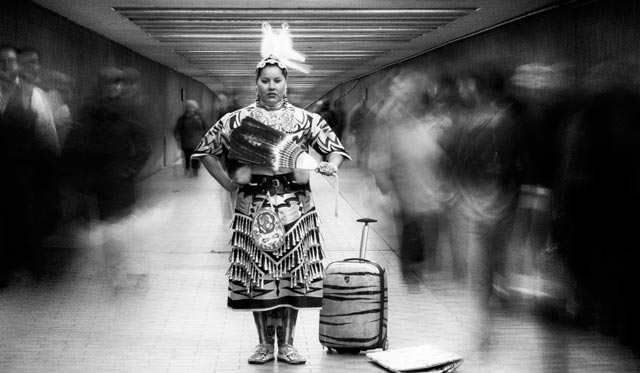
Tonight, from 10pm to midnight, A Tribe Called Red will be performing in the Grand Hall at the Canadian Museum of Civilization (CMC) in Gatineau.The three DJs that make up A Tribe Called Red are Bear Witness, Ian Campeau (a.k.a. DJ NDN) and Dan General (a.k.a. DJ Shub). MTV has dubbed them originators of their own genre called ‘electric pow wow’ or ‘pow wow step’ formed from a remix of traditional pow wow music with club beats. The group has developed a solid following in Ottawa and beyond, throwing monthly dance parties sampling from a broad catalogue and accompanied by projections of videos composed by Witness.

Grand Hall in the Canadian Museum of Civilization. Image courtesy Ottawa Tourism
There will be no video component for this performance because, as Witness explains “the general idea for Electric Fields is to find different ways to work with spaces and any screens would take away from this.” Instead the group are going to realize an idea they have been thinking about for years now. “When this project came up it was an opportunity for us to try out a bunch of things that we have been wanting to do” says Witness. They will arrange themselves and their gear a small circle in the middle of the dance floor, as apposed to being on stage, which is their typical setup. “We are going to be setup with our backs to each other and people are going to dance around us, like at a pow wow, where you have a drum in the middle and people dance around” explains DJ Shub.


For this performance they will also be working with a singer, Rhonda Doxtator, who is one half of the Pimadiziwin Singers. “We’ve never played a show with a singer before, who is going to be singing with us live, so that is going to be exciting” says DJ Shub. Doxator has performed with A Tribe Called Red in the past as a dancer, but for this night she will feature as a live vocalist for a few of the songs.

A Tribe Called Red. Image courtesy of New Forms Festival
The group are navigating the gap between the interests of their club crowd and an arts crowd. “We are going to shake up the CMC, like literally.” says Witness “Our music tends to do that. We want to shake those archives up. Shake ‘em old bones. It’s like we are going in there to play for those people, those energies that are stuck in that space. It is going to be a lot different energy than playing in a club…It is such a charged space, being in the CMC, the history of the CMC and all the artifacts, belongings and well, people who are housed there. It is an interesting space to take over.”

With three DJ’s playing at the same time, they alternate at taking the lead with DJ Shub adding scratches and flares using more ‘traditional’ turntables. “We work as a group, more than three DJs on stage doing their own thing” says DJ NDN “Sort of like a band almost, but not really. We are all improvising with our own instruments.”

Red Skin Girl single cover image by A Tribe Called Red
To date, A Tribe Called Red have released one single; Red Skin Girl. “The reason we only have Red Skin Girl out as a single is because it is the only one we have licensed to use the samples for. And that is why we give the rest away.” Red Skin Girl is a remix of a round dance song by contemporary pow wow singing group, Northern Cree. In addition to the vocables in traditional pow wow, round dance often includes English lyrics; stories of love and heartbreak. A Tribe Called Red have used the distinctive two step swing of round dance, speeding it up, adding layers and bass. You can listen to it here:http://soundcloud.com/a-tribe-called-red/red-skin-girl-atcr-remix

DJ Shub explains that “with any type of sampling music it is always difficult and expensive to get cleared. But there is light at the end of the tunnel because our manager has come to an agreement with Cannon Records, so hopefully they will be opening up their catalogue for us.” Witness adds: “the next step now is to start recording. So we are bringing people in to do studio sessions so we own all the tracks, and get out of having to license samples.” For now, you can download their music for free from SoundCloud: http://soundcloud.com/a-tribe-called-red

As recordings of pow wow music only go back 40 – 60 years, with the cultural ban only being lifted in the 1960s, most of the source material they want to work with is still under copyright. “Before that people were part of sideshows and wild west shows and could perform as part of that, so things survived. But as far as what you could do in your community…nothing” explains Witness. A lot of archival material exists in the US, in institutions such as the Library of Congress and the University of Indiana. The group are interested in exploring these older archives and just did a project with UCLA, where they were sent digital copies of recordings taken in the 1930s and etched onto wax cylinders. Their result, General Generations, can be heard here: http://ethnomusicologyreview.ucla.edu/journal/volume/16/piece/471

First published on Artengine 25 November 2011

Thursday, November 24, 2011

Electric Fields: Church Music

Roger Tellier-Craig will be one of the three performers showcased tomorrow night at 9pm at St Brigid’s Center for the Arts a part of Electric Fields. Two other performances will be Martin Bédard and Jean François Laporte. The line-up has been orchestrated through collaboration between Artengine and Montréal based electro-acoustic festival Akousma.


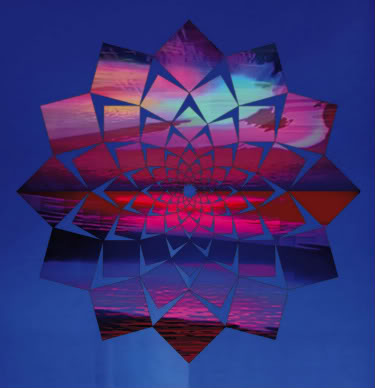
Le Révélateur – Fictions [Gneiss Things; 2011]

For Electric Fields Tellier-Craig will be performing live with a late 1970s Roland analogue mono-phonic synthesizer, blended with tracks from his new record Fictions. The structure of the music is computer sequenced, but the lead voice will be performed by hand by Tellier-Craig on the synth. Normally, when Tellier-Craig performs he does so as a duo under the name Le Révélateur, with Sabrina Ratté who creates corresponding moving images that play homage to late 1970s early 1980s computer video artists like Lillian Schwartz, Laurence Gartel, Toshio Matsumoto, Larry Cuba, Erkki Kurenniemi, etc. but the focus for Electric Fields will be purely on the sound.


Roger Tellier-Craig. Image courtesy of  Sabrina Ratté.

Known mostly from his time as a guitarist in the instrumental, minimalist post-rock bands God Speed! You Black Emperor and Fly Pan Am, Tellier-Craig has always been interested in synthesizers and electronic music. After overcoming the learning curve required to play the synth, he was hooked. “It just so much more sense to me than playing guitar. Guitar has never been something I really liked that much.”

Tellier-Craig has an interest in the historical legacy of older technologies. “When I first heard sequencers I thought they were cheesy and found them kind of kitsch.” But as he dug further into the technology and it’s history he began to realize that at some point in time synthesizers were new, and their kitsch associations have come through overuse in cinema, television and mass media.

He became interested in recontexualizing synth sounds by putting them in conjunction with other sounds from different eras. Tellier-Craig combines dense atonal and discordant sounds with new age music, with all it’s excessive historical baggage. He contrasts references to the Berlin school of electronic/pop music with density and noise inspired by Iannis Xenakis’ pioneering use of mathematical models in music. This mix-up and confusion is something that interests Tellier-Craig; he sees it as a challenge to move beyond comfort zones and familiar styles. While he takes inspiration from older music and technologies, his aspiration is for his music to move beyond updating and seek out challenging and uncomfortable surprises. The reverb inside St Brigid’s will present a different kind of challenge, and will require some adaptation to work with the ten speaker surround sound system and the acoustics of the space.

All music on the night will be taken from his latest album Fictions, with a limited run of 500 there are only 100 left to purchase online from the label Gneiss Things and Forced Exposure. Listen to a sample from the album, a track titled Age Maze, which will feature in the Electric Fields performance:http://soundcloud.com/le-revelateur/age-maze

First published on Artengine on 24 November 2011.

Wednesday, November 9, 2011

Electric Fields: Swimming in Sound


Champagne Baths. Image courtesy Wikipedia Commons


Bring your swim suit to this one-of-a-kind sound performance at Ottawa’s first municipal swimming pool. Composer and percussionist Jesse Stewart and new media artist Rob Cruickshank will perform at 10pm on Friday 25 November at the Champagne Baths, 321 King Edward Drive. Capacity is limited; advance tickets can be purchased for $10 from everybody@artengine.ca


For this performance, Stewart and Cruickshank will flood the space with percussive and electronic sounds. “I want people to be swimming in sound” says Stewart, who often experiments with water in his work across visual and sonic media.


Stewart’s large transparent drum kit will be staged on a platform in the pool, to appear as if it is floating on water. Throughout the performance Stewart will switch from playing his drum kit to dipping other percussive instruments, like gongs, into the pool. “The addition of water, lowers the pitch” explains Stewart. People swimming underwater will hear these warped acoustic sounds, which will be picked up by underwater microphones, called hydrophones, floating below the surface of the pool.


The hydrophones have been specially created by Cruickshank to transport the sound in the pool back through speakers into the space. Performing outside of the pool, Cruickshank, will be relaying and electronically processing the sounds he collects from the microphones, live. His performance will also blend in his own synthesized creations to the sampled sound he will process.


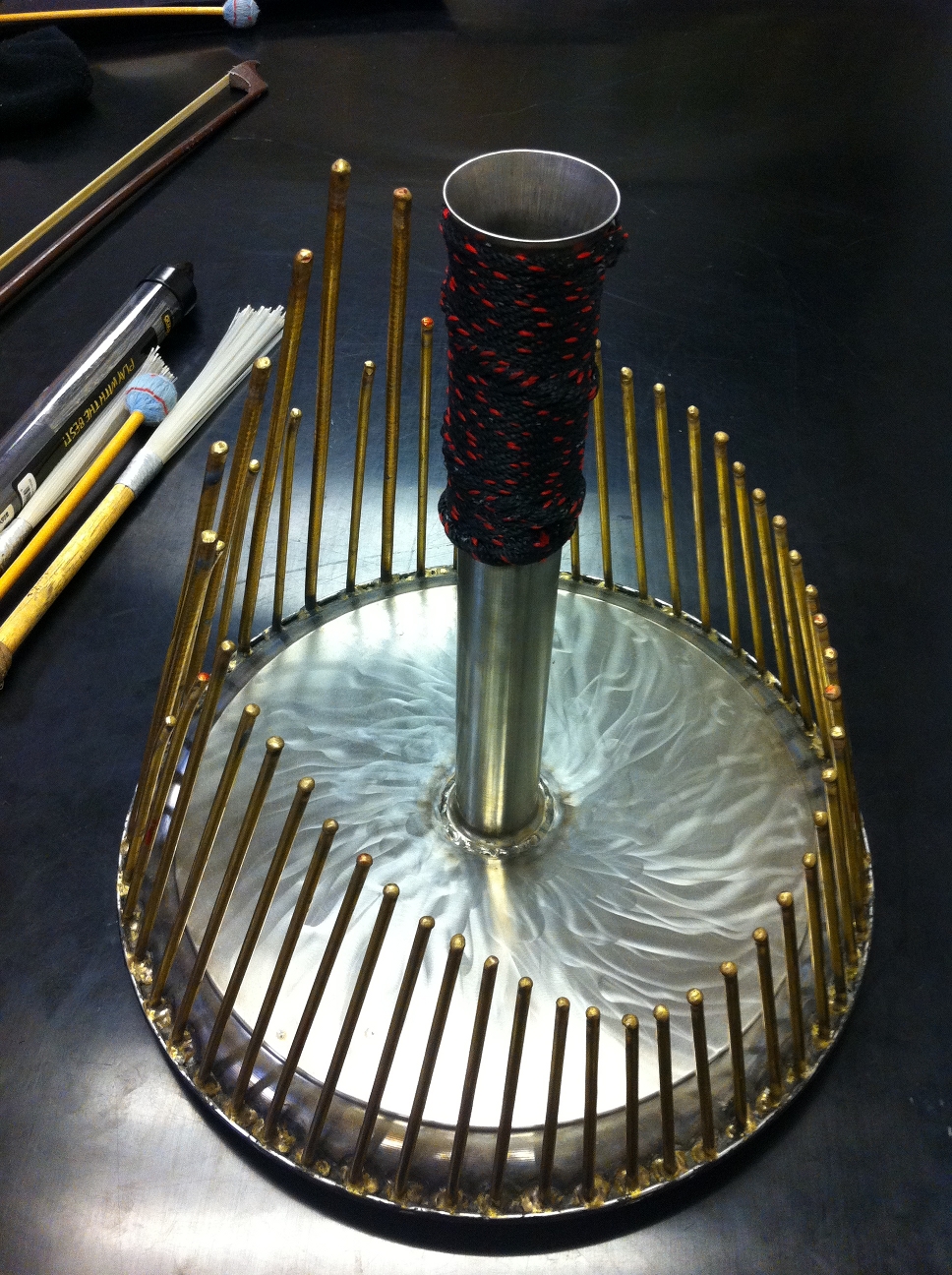
Waterphone


Audience members will also be treated to a performance of Stewart’s waterphone: an instrument constructed from bronze rods welded to a metal base that contains water. When struck or bowed, the vibrations of the bronze rods resonate through the hollow base. Sloshing the water around inside the base warps the sound, creating a series of eerie bent notes. The sound this instrument produces has a strangely electronic quality—an ambiguity the artists want to harness. They will blend acoustic and synthesized sounds and physical and electronic manipulation, to the point where it will be difficult to discern the difference between the two.


Stewart and Cruicshank’s audible landscape will span from haunting electronic sine waves to irregular jazz rhythms. They have a structure in mind, but their performance will be “largely improvisationial” says Stewart.


When they are performing they will respond the unique sound properties of the pool with it’s echoing tiled surfaces and potential for underwater phonics. “It is such a live space” adds Cruickshank. The unique reflections and reverberations of sound, shaped by the surfaces of the building’s interior, the water and the audience, will determine the character of the sound audiences will hear on the night.


Stewart and Cruickshank have never collaborated before. Their pairing has been co-curated by Vague Terrain and Artengine. “At a base level the project builds a bridge between the Toronto and Ottawa art communities” explains Greg Smith from Vague Terrain; a web based digital arts publication based in Toronto. Vague Terrain and Artengine have worked on projects together before, but these have mostly been virtual. Swim Sound is the first project that has branched out into real space, and fitting with the theme of this year’s Electric Fields is concerned with the particularities of a very distinct acoustic environment.


Stewart is an composer, musician, artist, and Assistant Professor of Music at Carleton University, Ottawa. Local audiences may remember him, and his transparent drum kit, from his performance under Barnett Newman’s $1.8 million dollar Voice of Fire painting at the NAG, or his recent exhibition of installation-based visual art at the Karsh-Masson Gallery.


Cruickshank is a multi-disciplinary artist, based in Toronto. He has been a board member at the artist-run centre InterAccess ( http://interaccess.org ) and has a deftness with electronics, which he will bring to the performance; having wired up his own underwater hydrophones and custom built the synthesizer he will be performing on.


The project has fostered some very ambitious thinking alongside creative problem solving. At one point in the evolution of the project the duo were brainstorming with architect Adrian Blackwell to put an iceberg in the pool. Shifting to accommodate the regulations that come with working in a public space, restrictions about working around water, and specific requirements of working within a historic building, as well as the complexities of remote planning, has seen the project evolve over time. It is a process that will only come to an end in the moment of the performance, making the process an experience and exploration for both the audience and artists.


The performance will last for approximately half an hour. Swimmers, please come early to change. Please note that the water at Champagne Baths is cooler than most, at a tepid 80ºF/26ºC. Wheelchair access is available, please contact Champange Baths 613-244-4402 for more information.


Swim Sound is presented in collaboration with online journal Vague Terrain.


First published on Artengine on 9 November 2011

Monday, October 31, 2011

Post-Riverdance: Colin Dunne at the NAC


Colin Dunne Out of Time. Image courtesy of Tristram Kenton.

If you are an Irish step dancer, how do you recover from the success and horror that was Riverdance? Colin Dunn‘s answer is to add things: spoken word, contemporary dance gestures (with arms), whistling, media projections of archival footage, one very minimal white-box prop, and the collaborative input of a sound designer. His post-Riverdance performance Out of Time took place at the NAC’s Studio last Thursday, Friday, and Saturday evenings, incorporating all these things.

Dunne’s use of pre-Riverdance historical footage adds a wash of nostalgia that could have been overly sentimental if it wasn’t for his monologues. There is a bitterness to his stories, which make you aware of the gruelling hours spent training, the horrendous competitiveness of national tournaments, and the cultural tsunami of international success. Dunne serves extra-large helpings of pantomime throughout: “Do you want to see my hornpipe?” he asks, repeatedly. Have you ever tried to walk silently in mic’d tap shoes? Dunne tries to. Then there is the moment where he comically pulls microphone wires out of his pants. He tells of escalating feats of virtuosity in step dance battles: dancing on a greasy plate; a greasy plate on a barrel; a greasy plate on a barrel, on a table; a greasy plate on a barrel, on a table, on the roof. All without breaking the plate!

At times he shifts gears from acknowledging that, yes — with its high kicks and static top-half — Irish step dancing is awkwardly funny, to showing us that he is, actually, extraordinarily talented. This is a point he makes plainly obvious when he runs a news clip about the time he won every accolade for Irish step dancing at the age of 10.

You never get to see sound designer Fionan de Barra during the performance, but he is the wizard behind the curtain. The magic he spins allows Dunne to dance with himself: echos and loops to make it sound like, at times, there is a whole troupe of dancers on stage. At one point de Barra formulates a type of auto-tune for tap shoes, where the pitch is altered so percussion becomes melody.

All in all, Out of Time is an interesting compilation of old stories, new media and very fancy footwork – and it is one of the highlights from a very impressive dance line-up at the NAC. You can check out the full program for the 2011-2012 season here.

First published on apartment613 on 31 October 2011

Thursday, October 27, 2011

Migration and Memory at Gallery 101


César Damián. Memory/Migration, image courtesy of Gallery 101


There is barely a country in the world that is untouched by the flows of migration. Propelled by hardship, war, and opportunity, international migration is a trend that is rapidly increasing. Mexican artist César Damián has traveled to Ottawa this week to install Migration/Memory, which opens tomorrow at Gallery 101. The exhibition explores the experience of migration and its impact on identity, memory, and cultural transplantation.


Visitors to the show will see portrait photographs of migrants suspended in jars that float and glow in the darkness over puddles of water. Audio tracks of people speaking of their personal experiences and explaining what migration means for them seeps through the space. Formally trained as a photographer, Damián has also begun working with video, and a recent work will be projected through the distorted surfaces of a glass jar.

Damián has been brought to Ottawa by Patricia Deadman, a member of the Aboriginal Curatorial Collective. The two met in Banff and have been involved with a Canadian-Mexican exchange that has resulted in an exhibition in the Yukon Arts Centre in 2009, and continues with this exhibition.The jar is a metaphor Damián uses to reference how memories are contained and travel with people as they move around the globe. His aim is to provoke questions about how migration has defined everyone’s personal stories of who they are and how they belong. Just how fluid these stories and memories are - and how fluidly people cross borders – is alluded to in the sounds of flowing water which accompany the video and the puddles that seep over the floor.

Migration/Memory is on at Gallery 101 (301 ½ Bank Street, 2nd Floor) from October 28 – November 26, 2011. The opening reception is tomorrow night at 7pm and includes an artist talk at 7:30pm.

First published on apartment613 on 27 October 2011

Tuesday, October 25, 2011

BioArt in Ottawa: An interview with Andrew Pelling

Jaenine Parkinson talks to Andrew Pelling about two collaborative art works that bridge art and science, which he was involved in presenting at the Open Ottawa Libra conference held at Arts Court on Wednesday September 28, 2011. Andrew Pelling is Canada Research Chair and Assistant Professor in the Departments of Physics and Biology at University of Ottawa. He heads up Pelling Labs, a laboratory for Biophysical Manipulation, housed in the University’s new Center for Interdisciplinary Nano-physics.



Andrew Pelling and Daniel Modulevsky Organ Re-Purposing Bioreactors (2011)


Jaenine Parkinson: Could you explain to me exactly what was going on in the two pieces you had at Open Ottawa Libre? Maybe we can start with the tissue culture piece, that you made with your student Dan Modulevsky? From what I gathered, it looked like, there were two bits of steak? And you were, someone said, sucking the cells out of them?


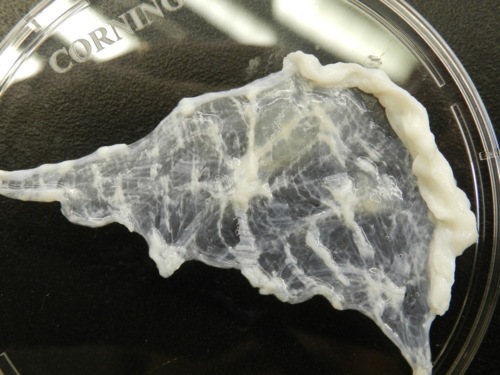
Andrew Pelling: Yes, we were extracting the cells out to leave behind what we call an extra-cellular matrix. It’s like a scaffold that cells grow on, it’s made out of collagen—a protein. There are cells in tissue that make the collagen and then there are other cells that make muscle and nerves, and things like that. We have been developing this process to remove all the cells and just leave behind the matrix. Which is great because, one, for a practical reason, to make the matrix in a lab is unbelievably expensive.



Andrew Pelling and Daniel Modulevsky Organ Re-Purposing Bioreactors, detail


JP: Oh, it seems like a highly detailed process; so you can actually synthesize it?


AP: You can, absolutely, but it is incredibly expensive. I’m not sure why. It’s not actually very hard. I don’t know what it is that makes it so costly. There are a lot of proprietary products out there you can just buy to synthesize it from pure collagen. But, for what ever reason it is very expensive; to make a large piece.
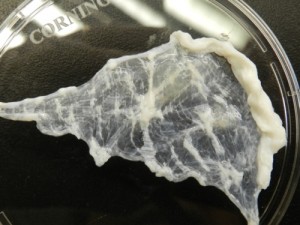


Decellularized steak


JP: So it’s use is primarily for recreating new tissue, with different cells in it?


AP: It is part of a huge push called regenerative medicine. Because you can take stem cells and coax them into being anything, like heart cells. But then you’ve just got a blob of heart cells and you need a structure. One way to build that would be to make it artificially, to create these collagen scaffolds in the shape of a heart, and put your cells onto it. That’s one approach and it is expensive. But it is very controlled. So, a few years ago a group took some hearts and got rid of the cells (decellularization) and there you have this scaffold of a heart. Of course, now you have to kill one animal to make a heart to put into another animal, so I’m not sure if it really makes much sense. It is also not very interesting to me personally, it’s kind of a standard thing that can do with this technology.


What we got interested in started with the little bit of animal work that’s going on here. In many cases you will study one part, in our case we were studying the aorta and heart disease, but the rest of the animal gets tossed, and it is quite wasteful I think. So I started thinking, well what else can we do to get more value out of this life that we have just ended? I just felt very guilty about that whole thing. And we started thinking about what about hacking the organs that are in there. Sort of bio-hacking.


JP: When you use the term bio-hacking what do you mean?


AP: Very much like you would in technology where you hack a piece of technology to repurpose it, use it for unintended purposes. So like Protype D with their printers. So, I thought, why can’t we do that with these organs? Can we take muscle and get rid of the cells and create an new structure that doesn’t currently exist in nature? Can we create little pumps that join to little arms and start putting them together to make monstrosities or tools and devices that would be bio-compatible? It is just something nobody is doing, so it just really attracts me. It’s so weird, but we have the technology. It is so, easy to get rid of cells and put whatever cell we want in. So, we can take a heart and put kidney cells into it; so it’s this heart-kidney. You just need a couple of electrodes to make it pump. You could exploit some of the biology of these kidney cells, to, say, pump and filter at the same time, or who knows. We do a lot of work with micro-fluidics and micro, miniaturized technologies. We spend a lot of times making these things synthetically, well could we make them organically? Then if it is all biological it will be easier to put into something as a device, rather than a new organ.


JP: And always the ethics comes up…


AP: Absolutely.


JP: What is it like working within the University framework? What sort of controls do they have in place around this type of work?


AP: Yes the University has good ethical guidelines, especially in terms of how you handle an animal, or bio-hazardous stuff. But, a lot of our work doesn’t actually involve animals. There are things called cell-lines which are immortalized cells. That just grow, and grow and grow and grow and don’t need a lot.


JP: I was reading your blog, plasticbiology.net there is one from a cervical cancer victim who died in 1951.


AP: That’s a really famous one: HeLa.


JP: It seems bizarre to me that this woman, Henrietta Lacks, died from a horrible disease, in 1951, and a part of her is still living. It is kind of amazing and horrifying at the same time…


AP: It is completely crazy when you sit down and really think about it. There is more of her biomass now then there ever was. Every lab in the world has HeLa cells. I’m sure this has been thought about by other people, but it is such a bizarre phenomenon. What’s even more strange is that it is so easy to genetically modify these things. To create new cells that would have never have existed. It’s bizarre how much power we have.


JP: Then there is this sort of fear/fascination blend to it, and many people just don’t want to go there because we don’t have the ethics yet to deal with it.


AP: Well, there are a tremendous amount of ethical guidelines. You have to get certified to do animal work and there are rules and regulations to minimize suffering. Although, it is interesting, because Canada does things a lot differently from the UK, where I used to work. I think maybe North Americans are a bit more squeamish. Some of the rules that are in place aren’t actually better for the animal, I think, but they just don’t look as horrific.


JP: But do ethics come into it when you are thinking about these projects?


AP: I’m not an ethicist, I think there are big issues there and sometimes I purposefully say stuff just to provoke ethical questions.


JP: I suppose half the attraction is to play with that boundary line?


AP: Absolutely, that is definitely part of what interests me, is that pushing, always. But, at the same time I would have a really hard time growing mice for the sole purpose of bio-hacking. We have these mice already and what we are working on already is a collaboration with a medic who has discovered a protein that minimizes, and maybe, perhaps could cure heart disease. So, there is real reason to do this work and there is real merit behind it. And what really bothered me at the end, is this ethical thing, we have this entire mouse, minus a heart, that’s just getting incinerated. There must be something we can do with this.


JP: Is this where the science stops and the art kicks in? Because, you don’t have an artistic background, do you?


AP: Well I did go to an art school when I was younger, and that’s where I learnt to love math. Some people get confused by me sometimes, some people call me an artist, some people call me a scientist. I like to think of it more as just being a creative person. And I don’t think there actually is much of a difference. I think it is more a medium you work in.


JP: Except with science there is more of a focus on purpose, where as exploration is more the purpose in art.


AP: In science there is more of a push for technologies, applications and profit. I like to keep my lab more in the field of pure exploration, curiosity driven. But it is getting harder. Although there are still grants for that – my main operating grant is called the Discovery Grant – its mainly for that fundamental research. It’s a federal grant, most science Professors have access to it. Although, I like to push those boundaries a little further than most. The Discovery Grant is much more open ended, but pot of money is much smaller than with industrial grants.


JP: So where are you going to next with this tissue culture project?


AP: The work we are doing with decellularization is a slightly different twist on regenerative medicine, where it’s not so much about making transplant products, but about making devices and things you can use. Integrating them with micro-fluidics or biosensors, or who knows. We can either spend years and years developing our own mechanical or micro-mechanical device that pumps or we can use something that already there. These aren’t trivial issues, but this is another way of thinking. Specifically, it’s not a way not many people are looking at right now, and that is why it is interesting. It’s more just stepping into the dark and seeing what happens.
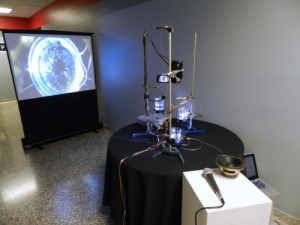


Andrew Pelling and Donna Legault Darkfields (2011)


JP: So the work that you did with artist Donna Legault, that is completely different.


AP: Yeah, that was interesting, because we just got shoved in a room and we didn’t even know each other.


JP: Oh, how did that happen?


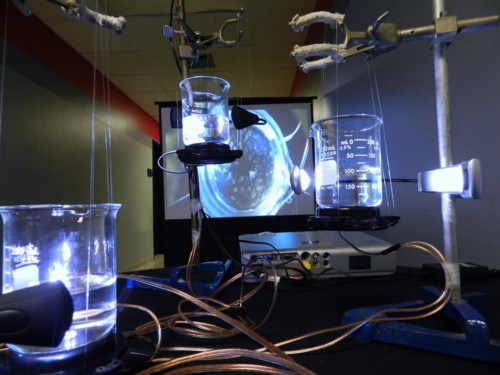
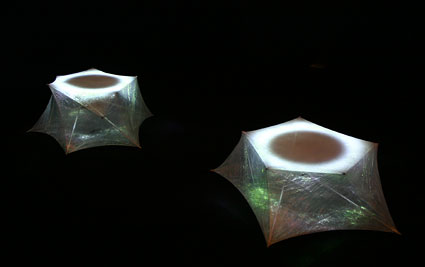
AP: Julie DuPont, who is the Cultural Planner for the City of Ottawa, was organizing Open Ottawa Libra and she arranged a meeting between a few of us at PrototypeD. We were just going to see their space. We ended up talking about Open Ottawa and some themes for it and all of a sudden we were planning a whole bunch of stuff for this event. Donna and I met there I guess because one of my previous art-sci things was this cell sounds project and we were just introducing ourselves and I talked about that. Then it turns out she is a sound artist, so there was this connection. We came up with some crazy ideas about using sound to manipulate cells. I don’t know if any of that will ever turn into something. But she came to the lab one weekend and we tried a few things out. She has these base shakers, and she has been working with infra-sound, low frequency sound, feeling and visualizing sound. We put some beakers on top of these base shakers, which vibrate to create little standing waves. It became about visualizing sound with water. The other consideration was capturing the waves, you actually have to have the lights at a certain angle, to scatter up into the camera. We were making sound visible, but also making these waves visible.
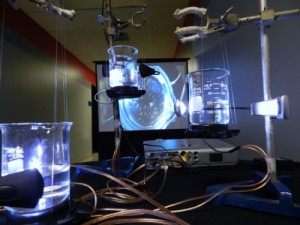


Andrew Pelling and Donna Legault Darkfields, detail


JP: So could you explain a little about the cell-sound work you had done previously?


AP: That was called Dark Side of the Cell (2004) www.darksideofcell.info and that was with an artist I have been working with for years Anne Niemetz She and I met in UCLA, we were both graduates. Our advisors were organizing this huge art-sci exhibition at the Los Angeles County Museum of Art (LACMA) which was this year long, 10,000 square foot exhibition about the interface between nanoscience and art. Since I was working on these cell sounds and she is a sound artist, our advisors kind of pushed us together and asked us to do the sound design for the whole exhibit. Again, we started talking, and she was doing an MFA so we developed this piece called Dark Side of the Cell. I was using this device called an atomic force microscope. It is sort of like a record player needle on the end of an arm, you can use it to image atoms and image cells. So I was using it to feel how cells move. Which was, at the time, completely bizarre stuff to do in the field. And I discovered in particular yeast cells these small low amplitude oscillations in the cell wall; high frequency, about a thousand kilohertz. They were very transient, they would come and go. The digital data looks like sound waves, like a .wav file. That inspired my advisor and I to convert this to sound, so we could listen to these cells. So I had that going, then I met Anne and we developed this Dark Side of the Cell installation. Which is a concert of pure cell audio, untouched, unaltered, just the volume has been changed, and we organised it into themes, for this immersive sound environment. We had big cell sculptures and projected onto them images of the cells you are actually listening to. The show got a surprising amount of press, and Anne and I have been working ever since on different things. It’s a little harder now that she is in New Zealand.
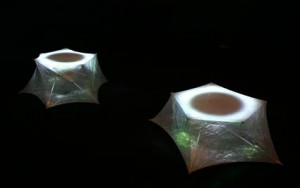


Andrew Pelling and Anne Niemetz Dark Side of the Cell (2004) installation detail


JP: Didn’t you met up with her recently in Perth?


AP: Yes, she and I went to SymbioticA, which is this bio art center in Western Australia. I’ve known Oran Catts and Ionat Zurr from the Tissue Culture and Art Project for a while now. That trip inspired my Lego project. I did it in preparation for going out there. Again it was triggered by a feeling of guilt. When you work in a lab as a student you don’t really think about where a lot of the things come from, or are wasted. But when you are the guy running the lab and buying these materials you see that there is a tremendous amount of waste – and plastic – bio materials and animals. We have a culture of mass production and we have a huge mechanism in our society for it. And none of it its recycled, it’s all incinerated, because you are worried about biohazards. And these are legitimate concerns. But there is a huge amount of waste, and it doesn’t really get talked about. So I thought, why don’t I think of a way to push a debate. Not necessarily to answer any questions, but just to bring it to the front. And that was the Lego project. It is this idea that even living things are plastic in our lab. We can totally manipulate them; get them to do whatever we want.



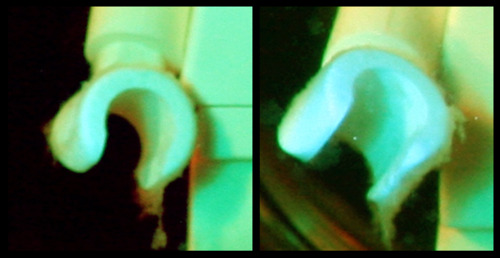
Andrew Pelling Semi-Living LEGO Minifigs (2011)


JP: And cells are like these little Lego building blocks anyway.


AP: Exactly, so I took these HeLa cells and inserted a jellyfish gene – again, because I could – to make it glow. So you have this human-jellyfish organism now. It’s just this Frankenstein. But again, you just buy the products off the shelf, it’s all plastic, you don’t have to do anything special, I could teach anybody to do it in an hour. It is kind of scary. We do it every day. It is just this tool we use. And then I thought, how can I represent it – and Lego figures were the answer.


JP: It also brings it a bit closer to home, turning this jelly-like blob into a skin, and referencing the fact that there are human cells being used. Because that is the scariest thing, for many, because not only can you change our food and animals, but you can change us as well.


AP: Of course, in reality, could we do it to a human? Probably. It would be a lot harder, probably. But conceptually it is all there.


JP: And then there is the whole ‘slippery slope’ argument. If you take one step, why not take the second and third.


AP: And it is all commercially available. If you have enough money you can do it. Anyone can do it. Especially with that whole DIY bio thing right now.
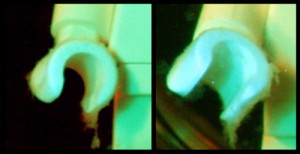


Andrew Pelling Semi-Living LEGO Minifigs, detail


JP: So did you present your Lego work at SymboticA?


AP: I showed some pictures and just discussed it. Of course, at SymboticA these are issues they have discussed at length, because that is what they think about all the time.


JP: Did you see anything interesting while you were there? What other problems were people considering?


AP: Well the other aspect of our work is that we try and build mechanical devices to manipulate cells. Stretch them and pull them and poke them, to see what happens. And what shocked me was when I showed up at SymboticA one of there students was building exactly what we were in the middle of building and he had done it ten times better than us actually. It was amazing, here are a bunch of artists building the same device for the same purposes. It was so strange. Our project came from our work with the heart. If you think about the aorta it is constantly expanding when your heart pumps, there is a pressure on the veins and arteries, and they expand. So the cells in those walls are being stretched and compressed and undergo different types of stress and strain.


JP: And you just wanted to see what the upper threshold is?


AP: I just really wanted to image, video record, how they respond. It is amazing, these are just such simple perturbations but when we look at the data carefully the responses are unbelievably complex. We are sort of at a stage where we don’t even have enough physics to describe what is going on there. We don’t have the models. We have some models that sort of work, but what we are finding again and again is that when biology does these things, these physical things, it doesn’t behave the way we expect it to. And you would never have discovered that if you weren’t really looking. For many years people weren’t looking and they derived a lot of physical equations that are very elegant. But they have no basis in describing a real cell. That is why we just look.


For eons science has just been about understanding how cells work in normal environments and circumstances. There are still a lot of questions to be answered, and a lot of knowledge there. But what has been interesting me much more now is what happens when we put them in very extreme conditions that have nothing to do with normality or make completely new types of cells and new types of ‘organs’. Let’s attach a lung to, I don’t know, a piece of steak, and see what happens.


JP: Yeah, I remember Stelarc grew an ear on the back of a mouse and it was really controversial.


AP: That is really part of the inspiration. Along with Steve Mann in Toronto with his electronic surveillance and integration between bodies and electronics. So could we start pushing our science away from just try to understand how things normally behave. What I am more interested in now is how they behave under really extreme, artificial conditions. Which is really interesting, especially if the future is this integration between technology and biology. I bet there are a lot of responses, the potential of cells, that we don’t even know exist.


JP: Do you think you would be doing this type of work if you didn’t have access to all your equipment?


AP: Well that is what is so cool about the DIY bio movement. In a lab a company could sell us a piece of equipment for say, $12000-15000 dollars, but it is really a couple of hundred dollars worth of parts. We have built our own equipment out of garbage and some of it is even more accurate than what we have bought. So you could do it. The general public can do it. For instance, our centrifuge, would cost $10,000, and I just read an article the other day of someone constructing one from a salad spinner and a drill.


JP: What about opening up these labs for other artists to come and work in? Does that happen?


AP: It does, Anne Niemetz has worked here, twice now. And I am hoping Oran Catts and Ionat Zurr will come over sometime as a residency. There is no formal mechanism but everything we are doing is so in the middle of art and science anyway, it all fits. So really all you need is some safety training.


What we are working on in the lab at the moment is miniaturization, to create micro-fluidic devices. We have developed one to stretch cells using vacuum. When we apply a vacuum to one of the chambers they shrink, and that allows us to pull on the cells. And each is individually controlled. We are experimenting a lot with this type of silicone technology, because we can integrate electrodes.


The other project we are working on uses two lasers, that we point at each other. Then we have a fluidic channel that a cell floats down. And when it hits these two lasers, the lasers can hold it. So very Star-trec, tractor beam. Then by manipulating the power of the laser we can start stretching the cell. I don’t know exactly what we are going to do with this. But it is amazing to see that it is possible. The idea that we are toying with is that if you manipulate these cells, is to find out if you stretch a lot of cells and collect them afterwards, and grow them will they grow differently? If we do that with stem cells, do we get a different response? We will see, I guess.


We are also working with micro tumors that will grow in chambers of these micro-fluidic devices, so we can study how they behave under different mechanical situations. Because, when cancer is spread the first thing that forms is these micro-tumors, a tiny collection cells. And they are very sensitive to the mechanics of their environment. But exactly how, and what is going on and why, we don’t know. This is one way we can study them.


Usually how I develop a new project is that I just have some image in my head of a cell in a particular environment. I have no idea why it is there, or how it got there. But, let’s make this! Let’s just figure out how to do this. It doesn’t ever start with a particular question or scientific hypothesis.


JP: There seems to be dove-tailing end-goals here. What you are doing could have some application to medical science or it could be…


AP: Complete madness. Well I’m not a medic and I don’t like to say my research is about advancing medicine, because I have no business talking about medicine. A lot of scientists do this because it helps them get funding. But really have no business talking about medicine.


JP: But a lot of medicine is just an elaborate, educated guessing game.


AP: Absolutely, I have always said, we will develop the concepts and it is up to the medics to develop the applications. And actually decide if my findings do have applications or not.


JP: So do you have any presentations of your work coming up?


AP: I’m giving a bio-hacking talk at Concordia, Montreal on 1 November, which is open to the public. I don’t know if you know Tagny Duff, she is an artist and she had a residency at SimbioticA and I think she has almost got her own tissue culture lab set up there. Called, Fluxmedia, I think. It is a centre for bio-art and bio-ethics. Show some videos, of how cells move, which is quite incredible.


We use a silicone mould stamps, and the cells grow around it. When we pull it out we are left with a shape. We are studying how they fill that space back in. These angle of the mould has such huge effect on the rate, and which cells start moving and when and how they are communicating. It is called wound healing. The traditional paradigm for this is you make a line, a scratch, and you’d time how long it takes for the cells to heal. I thought, well what happens if you make two scratches? What happens if you start changing the angle here? What we see is there is a collective behavior going on here. The cells at the edges move as a unit. Depending on how steep we make the angle, we get different dynamics. If we make a really steep cut some cells don’t move and others do all the work. How that is happening and how they are communicating isn’t really clear.


JP: It is amazing, because this would happen in your body too?


AP: Yes, especially if you got cut. For fifty years people would just make a straight line, it was just never questioned. But there is anecdotal evidence of surgeons making jagged, zigzag cuts and them healing better. I came up with this idea because I was talking with two of my students suggesting that they try it. And just even convincing them to do it was so hard. Because, why would you want to do it? It is always done with a line, so we have to do it with a line. Why would we do it any other way?


JP: To see what happens.


AP: Just shift your mindset.


First published on Artengine and Vague Terrain 25 October 2011
Sunday, October 23, 2011

Plenty to see at this year’s EBA Open Studios


Thousands of toothpicks, all standing on end, cover the entire back wall of Karen Jordon’s studio. They make it look like the wall has sprouted fur, or a 5 o’clock shadow. It took Jordon over six years to construct the installation by hammering little notches into the wall with a nail and then inserting toothpicks. This is just one of many intriguing things to see at the Enriched Bread Artists Open Studios over the next two weekends. There are sculptures assembled by the sea in Marika Jemma’s studio, artworks that reflect everything to infinity by Kenneth Emig, knitted tree roots by Bozica Radjenovic, Victorian curios and specimens in Cindy Stelmackowich’s studio, and a dress made from plastic bags by Gale Kells. Plus — there is the added voyeurism of sneaking a peak inside the work spaces of many of Ottawa’s artists.

Over the sounds of DJ Michael Caffrey at the opening last Thursday night, there was urgent chatter about the EBA’s future. The roof of their converted factory was wrecked in the storm that ravaged Bluesfest earlier this year. Regional Group developers have bought the building and there are rumours that they eventually plan to build condos on the site. EBA is located on Gladstone just west of Preston Street and they want to stay in the area; they have a good relationship with the Preston Street BIA and support from local businesses. They still have a long-term lease on their current location and are determined to carry on.

The importance of the EBA collective was on everybody’s lips. “Enriched Bread Artists is the reason I stayed in Ottawa” says Natasha Mazurka, who moved to Ottawa in 2008 and teaches at Algonquin College. “Everyone here is so professionally active. It is so important to have that around you, because being an artist can be so isolating.” Evidence of just how productive this environment is can be found all around the city. Right now Mazurka is showing at espace Odyssée, Radjenovic is showing at Karsh-Masson and Stelmackowich has work at the Bytown Museum. Jordon has a show coming up at Karsh-Masson in February and Christo Pantieras will show at the Ottawa Art Gallery next year. Many of the artists teach all over the region and roam out into the community collecting materials and inspiration for their work.

There is still plenty of time to get yourself over there to have a look. The studios will be open on Friday 21 & 28 Oct, 6 pm – 9 pm; Saturday 22 & 29 Oct, 11 am – 5 pm; Sunday October 23 & 30, 11 am – 5 pm. If you need another excuse to go, the Stoney Martins and the Outriders will perform live this Friday at 8pm. Entry is free; donations are welcome.

First published on apartment613 23 October 2011
Thursday, October 6, 2011

Nova Scotian Conceptual Art at the NGC


David Askevold and Tony Oursler, Two Beasts (2007 -2010). Still, courtesy Oursler studio.

New visual arts contributor Jaenine Parkinson checks out the retrospective of Nova Scotia based conceptual artist David Askevold, opening at the National Gallery of Canada on October 7.

While born and raised in the USA, David Askevold (1940-2008) spent most of his artistic career in Nova Scotia. He has been recognized as a pioneer in the development of conceptual video and photo-based art. The large scale retrospective exhibition David Askevold: Once Upon a Time in the East contains 39 works from key stages in his career.

The first room of this three-gallery exhibition features photo-text ensembles and a number of film, super 8 and video works. One of the videos, Fill (1970) is, according to curator David Diviney, “quite possibly the first conceptual video art work ever created in Canada.” In this video the artist simply wraps a microphone with aluminum foil until the mass completely fills the screen. The crunching sound of the foil is picked up by the encased live microphone. Once the screen is filled with foil, a pair of hands reverses the process, unwrapping the mic.

This is classic conceptual art. What comes first, and what is most important, is the idea: an
abstract set of rules that describe a process. Wrap a mic with foil. Unwrap it. Conceptual artists, like Askevold, were not about creating fancy objects that showed off technical skill to make money on the art market. The materials they turned to, in reaction to all that, were words, documentary photographs, videos and performances. This is what makes up the bulk of the exhibition, and Askevoldʼs career. Beauty is not the point, although it can be found hiding in the repetitive gestures and loose narratives that characterize these works.

What is most interesting about this retrospective is that it shows how a conceptual approach—favouring ideas, rules and processes—is not a historical novelty. The final room of the exhibition has some of Askevoldʼs experiments with digital technology. Two works really stand out: What is Church? (2001); a digital collage assembled from photographs Askevold took of all the churches over 100 years old in Nova Scotia and PEI, and the video work Two Beasts (2007-2010); a collaboration with Tony Oursler, completed after Askevoldʼs death in 2008. Two Beasts is a grid montage of still and moving images collected by Askvold and Oursler. The images evolved from an unfolding series of instructions like “start at 12am, friday 13th, draw with eyes closed while listening to the movie sound track (Aliens 2), then take photos of objects given to you by family members, later try to shoot short video clips.” Both works bring conceptual processes and critiques into the present, showing their relevance for and influence on contemporary art today.

David Askevold: Once Upon a Time in the East runs until January 8, 2012. A curatorial tour will take place on Saturday, October 8, at 2pm. For opening hours, ticket prices and more information visit the National Gallery of Canada website.

Published: apartment613 on 6 October 2011 http://www.apt613.ca/2011/10/06/nova-scotian-conceptual-art-at-the-ngc/
Thursday, September 29, 2011

More than Maman

Louise Bourgeois, Maman, 1999. Photo by Magida El-Kassi
Working across mediums, movements and styles, Louise Bourgeois was a difficult figure for the art world to digest. She influenced and absorbed but always stood apart from so many artistic movements: surrealism, post-minimalism, feminism ...

Even if Ottawans seemed to simply get Bourgeois’ gigantic spider sculpture Maman from the moment it was installed outside the National Gallery of Canada (NGC) in 2005, many don’t know that she was an American artist, of French origin, and approaching the age of 90 when she created the work.

Bourgeois's nine decades of artistic innovation were brought to a close last year when she passed away at the age of 98, but a small Bourgeois exhibition currently on at the NGC can help provide a broader view and a deeper reading of a world-renowned artist who in the past half-decade has taken on a special kind of renown at the NGC.

“I was surprised with Ottawa,” remarked Jonathan Shaughnessy, Assistant curator at the NGC, on the initial response that Maman received six years ago. Shaughnessy may have anticipated the outcry that often comes with the appearance of contemporary public sculpture in any cityscape. Yes, initially there were a few grumbles about the cost ($3.2 million), a few critics who would have preferred a one-of-a-kind work (Maman is an edition of six) and a few others who thought that such a signature NGC work should be of Canadian origin, but overall, the response was roundly positive. Ottawa Citizen columnist Mark Anderson’s prognosis upon the unveiling summed it up: “She is cool. She is going to be a great draw.”

Anderson was right, on both counts. For Ottawa and the NGC, Maman is a fun, fierce, and fascinating landmark, treasured equally as a superstructure under which to congregate, a symbol for the city, and no small coup for the NGC curatorial team. Despite her overwhelming presence at the gallery’s front entrance, on any given day you’ll see scores of both children and adults drawn to Maman, clinging to her, and dangling from her spindly legs.

Of course the NGC also enjoys the art world kudos: having a Maman puts NGC on par with other major institutions that have one, including Guggenheim, Bilbao, Mori Art Museum in Tokyo, Leeum Samsung Museum of Art in Seoul, and many other galleries temporarily graced by a touring Maman.

Overshadowed by a spider
Immediately recognizable in Ottawa and the art world, a Maman is also iconically Louise Bourgeois. Although the immense sculptures overshadowed her other work, Bourgeois was unperturbed. “The spiders I have made over the last decade have been a big success,” she once said. “And I do not object to how such a statement might sound to others, because success is sexy!”

Maman, though, is just one of more than a dozen Bourgeois works acquired by the National Gallery since the 1990s. The resulting small-but-important collection is significant for a national institution that aims to provide international context against which we might frame Canadian art.

The most recent acquisition, Cell (The Last Climb), 2008, was purchased just before the artist’s death and has been on long term display. A few other works from the collection—including early carved and assembled wooden sculptures—also feature in Louise Bourgeois 1911–2010, a small exhibition that came about after the purchase of Cell.

“It wasn’t meant to be a tribute show,” says Shaughnessy, but it has turned out that way with the passing of Bourgeois at the end of 2010. The inclusion or both early and late works serve to bracket the artist’s entire contribution; the show offers a taste of Bourgeois’s enduring concern with human relationships, her unique and personal symbolism, and her innovations in modern sculpture—achievements that make her career globally significant.

Inevitably, any examination of Bourgeois at NGC must begin with Maman. We literally enter the gallery from between her legs; she presides over everything thereafter. Monolithic and daunting, her limbs taper to form gothic arches that cradle a sac of polished marble eggs high above. On a personal level, the artist fashioned the spider as a symbol for her own mother, a complex character described by Bourgeois as “deliberate, clever, patient, soothing, reasonable, dainty, subtle, indispensable, neat and as useful as a spider.”

More broadly, Maman is a nuanced study of motherhood reaching far beyond any one-sided Madonna-with-Child interpretation. This Maman is both predator and protector—frighteningly powerful and dutifully attentive. We do not need to know the artist’s personal story to respond to the work; we can use our own stories. Within Maman’s embrace “we are all reduced to children,” observed Kitty Scott, former curator of contemporary art at the National Gallery.

When considering the smaller works in Louise Bourgeois 1911–2010 we learn how Bourgeois‘s ambivalent relationship with her family fueled much of her output. As she once explained: “I have three frames of reference. I have the frame of reference of my father and mother, and that of my own experience. I have the frame of reference of my children. And the three are stuck together.”

The early wooden sculptures from the ‘40s and ‘50s were called personages by the artist and created as stand-ins for the family members she left behind when she moved to America with her new husband at the age of 26. Roughly humanoid, these abstract, totemic figures balance, just as Maman does, on narrow points—although here the stance is precarious and shaky. Bourgeois created some 80 of these personages over the course of a decade, a period marked with nostalgia, mourning, and guilt at the separation from her family.

Direct relationship with human scale
“Louise Bourgeois was one of the first true installation artists,” notes Shaughnessy while walking through NGC gallery space filled with personages that stand as tall as people, alone and huddled in groups. The overall effect evokes a cocktail party where the guests are self-conscious and lonely, gathered together in an attempt to ignore or relieve their alienation.

Installation view of Louise Bourgeois (1911-2010):
works from the Personages series and Forêt (Night Garden).
Collections NGC and Louise Bourgeois Trust,
courtesy Cheim & Read Gallery, New York, and Hauser & Wirth Gallery, London.
© Louise Bourgeois Trust. Photo © NGC.
This personages installation at the National Gallery is special because it realizes the artist’s wish to exhibit the works without bases. The figures are mounted on rods embedded directly into the floor—something galleries are reluctant to do—forcing viewer and sculpture to confront one other on the same plane, without separation. Be it dwarfed by Maman or matched by the personages, Bourgeois’s works impose a direct relationship with the scale of the human body.

Beginning with the personages and continuing with another work in the NGC collection from the 1950s called Night Garden, we see Bourgeois repeat a bulbous breast-like form. This form appears again in the artist’s red gouache drawings from 2007 that line the walls in final room of the NGC exhibition. In these drawings, five bulging packages are carried around the neck and shoulders by female figures, most likely representing the five members of Bourgeois’s family supported by a nurturing mother.
Louise Bourgeois, The Couple (detail) 2007, Gouache on paper, suite of 18,
Collection Louise Bourgeois Trust,
courtesy Cheim & Read Gallery, New York and Hauser & Wirth Gallery, London.
© Louise Bourgeois Trust. Photo: Christopher Burks
The exhibition concludes with another series of vertical, thin, human-scale bronze sculptures that echo the personages.Haunting, almost magical in quality, these sculptures (also from 2007) are formed from jackets and sweaters that are rendered ghostly in a white patina finish. The same connection to family and the body that haunted Bourgeois at her beginning of her career seemed to do so at the end.

Louise Bourgeois 1911–2010 is but a select tasting of the remarkable variety found in this towering and distinct artist. A much different narrative might be easily stitched together beginning elsewhere in her career—dealings with her patriarchal father figure, for instance, or even a path based on psychoanalytic theory. The breadth in the Bourgeois web is as complex as motherhood itself and the most enchanting aspect of the artist’s body of work.

Just when you think you might know Bourgeois, you’ll come across a striking contemporary piece that seems certain to be the work of an up-and-coming artist but instead bears her name.

Published in: Gurellia Magazine Issue #29, Volume 8, Fall 2011 http://www.getguerilla.com/issue-29-ottawa-feature6-menu-item

Monday, September 26, 2011

A Premonition of Artificial Hells

“In a world where everyone can air their views to everyone, we are faced, I think, not with mass empowerment but with an endless stream of banal egos.” – Claire Bishop


Claire Bishop is on a mission to re-scribe readings of participatory/collaborative/socially engaged/relational/dialogic art beyond moral interpretations. Her agenda hasn’t changed since her 2004October article where she challenged Nicolas Bourriaud’s aggrandizing claims for relational aesthetics. From this polarizing start she has been unrelenting in her push for a more sober take on the participatory art forms currently trending. So, you can imagine my interest in the launch of her new book Artificial Hells: Participatory Art and the Politics of Spectatorship. Supposedly released in spring this year, I can’t find a copy anywhere, and there is no mention of it yet on the publisher’s (Verso) website. Nevertheless, no book is an island, therefore, a lot of Bishop’s material is already floating around. What follows is a cursory guess at the types of things I think—and hope—she will address in her book. I will be glancing over the wealth of historical research that Bishop draws upon to contextualize and evidence her argument. Suffice to say, she has brought an overlooked history of participation in twentieth century art into the light. More than simply proving her thesis is no knee-jerk reaction this history serves as ample reason to read her book(s) for yourself. In the end, all this may become a preamble, in need of revisiting once I get my hands on a copy of her new book.


The title Bishop has chosen, Artificial Hells, doesn’t shy away from giving us a sense of where she stands on the subject. She sides with Sartre: hell is other people. Or, more specifically, hell is working as an unpaid performer in a participatory art project with other people, while enacting a predictable exchange that comes nowhere close to inducing the promised new and emancipatory forms of social collaboration and relation. Her title also situates her argument within historical linage of socially engaged art—artificial hells is the term coined by André Breton to describe Dada events of the 1920s. Bishop sees these events as an example of one of two trends evident in the history of twentieth century participatory art. Many Dada events were oblique, chaotic situations—artificial hells—intended to shake up participants and critique societal alienation; in what Bishop terms a ‘negation of negation’. The storming of the Winter Palace in 1920 is an example of a parallel trend that attempts to provoke collective creativity, oppose injustices and propose alternatives, in a type of ‘utopian realization’.


At the root of both of these, still prevalent, strategies is the belief in the automatic political efficacy of physical participation; something that Bishop and her philosophical inspiration Jacques Rancière refute. They argue that there is no direct correlation between an artistic form and political meaning. Artistic forms, participation among them, can be equally co-opted by competing ideologies. Bishop has spent a great deal of time and effort opposing the narrative behind participatory art that claims audiences are activated, awakened and empowered when artists give over control to participants. But she also goes further, asking: what criteria should we use, then, to evaluate participatory works critically and develop a frame of reference for discussing them?


Mel Chin, Fundred Dollar Bill Project (2010-present) Image: Jeffrey Bussmann via Flicker


If we evaluate these works by their ability to bring about social change, they fall short. Most artists do not wield the power, resources and time to bring about substantial long term change to the issues they highlight. As an example, Bishop cites Mel Chin’s Fundred Dollar Bill Project which aims to leverage $300 million from the U.S. Congress for lead pollution cleanup, by exchanging the same amount in ‘Fundred’ one hundred dollar bills, drawn by participants (mostly school children). Who, she asks, will be responsible for guaranteeing lead removal once the hand-drawn notes are presented to government? At some point responsibility needs to be handed over to social and political organizations. But exactly when and how this will occur is often beyond the scope of artistic projects.


Furthermore, artists who create socially engaged, participatory projects reject questions of aesthetics and often disregard the life of their projects beyond communication with their primary audience. Instead, they position their practices as working outside or beyond artistic concerns, in new interstitial zones. Such claims, Bishop argues, are disingenuous, as most of these projects are endorsed, funded, hosted and invested with meaning by art institutions, and engage art audiences. These projects are also seen as peripheral by socio-political organizations. By eschewing artistic interpretation or ultimate social responsibility, Bishop argues “a great swath of participatory art ends up floating in a comfortable non-zone where neither social or artistic criteria are being achieved/can be used as a basis for judgement.”


Bishop is often asked questions like “but surely it’s better for one art project to improve one person’s life, or draw attention to an issue, than for it not to happen at all?” But such questions are still founded on valuing a project’s role as a social agent, where it is good simply because it is intention is good, not because it produces anything good. We could, for instance, see Chin’s Fundred Dollar Bill Project as a petition. But if we value it only because it draws attention to an important issue, we are effectively saying that art is valuable only as propaganda. Art becomes reduced to a feel-good gesture aimed to relieve feelings of responsibility or guilt. A bandage over the cracks in society. It also places undue investment in the power of revelation. Believing that simply exposing an issue will bring about change. Bishop is adamant that her criticism is not aimed at convincing artists to become more politically active or responsible, but about articulating and appreciating art’s value beyond propaganda, beyond serving as a petition or publicity strategy. Art’s value, she contests, lies not in it’s ability to tote the ethical slogans of the day, but precisely because it exists outside of this. Because it can present contentions that cannot be read as morally exemplary.


Ultimately, this is a clash of value systems. A clash that Bishop has demonstrated as nothing new. At its bare bones lies a series of binary oppositions: active participation vs passive spectatorship, open text vs closed work, equality of access vs quality of result, real life vs spectacle, political morality vs artistic freedom, collective vs individual, process vs product, collaborator vs author, etc. My guess is that a fair chunk of Bishop’s book will lay out an artistic history that shows how these dichotomies have flared up and taken many different shapes over the course of the twentieth century.


Drawing on the work of sociologists Luc Boltanski and Eve Chiapello, Bishop has shown that these values have a deeper root in reactions to contemporary capitalism. Boltanski and Chiapello have noted that throughout history four critiques of capitalism continuously reappear: (i) a demand for liberation from oppression; (ii) a rejection of inauthenticity and disenchantment; (iii) a refusal of egoism and private interests; (iv) a response to suffering and poverty. Of these, the first pair are often expressed as an ‘artistic critique’ that deplores the loss of meaning and loss of a sense of what is beautiful and valuable within a society that standardizes and commodifies things, people and art. The second pair form a ‘social critique’ that rejects moral neutrality and individualism of artists and a separation of art from life.


These critiques Bishop equates with the two separate narratives that have arisen, in opposition, around socially engaged art work. For those who place value on the social and ethical side of the divide, a work is significant and successful when it models better behaviors or offers solutions, however short-term, to social problems. Alternatively, those who read these projects as art first and foremost base their judgements upon sensory responses to the material presented. Bishop explains “In this schema ethics are nugatory because art is understood to continually throw established systems of value into question, including questions of morality. It is more important to devise new languages with which to represent and question social contradiction.”


In etching out a critical framework for understanding the value systems behind evaluations of participatory work Bishop has been criticized for policing the boundaries of artistic practice and polarizing discussions into camps pitching “aesthetes” against “activists”. (Kester, 2006) But to those resistant to assessing and theorizing the value of art, Bishop describes the history of the post 1968 community arts movement as a warning. Emphasizing process rather than end results and basing their judgements on ethical criteria about how and with whom they work, rather than the character of their artistic outcomes, they found themselves subject to manipulation and eventually instrumentalization by right wing governments. From being an agitational force in the 1970s campaigning for social justice, it became, by the 1980s, a harmless branch of the welfare state. The kindly folk who could be relied upon to mop-up whenever the government wished to absolve itself of responsibility.


For practitioners who operate within artistic spheres, receiving funding and institutional support for their work, it is important to be able to articulate the value of the arts to avoid being put to use in the service of neo-liberal agendas as community builders, perception adjusters, social minders etc.


Bishop has noticed that many artists have internalized the pressure to find solutions to social problems. But, she argues, this is a task that artists are often not best equipped to undertake and the job is much larger than they can tackle on their own. Bishop sees this pressure to make art politically ‘relevant’ to the real world as having welled up from a lack of faith in the value of art as a de-alienating human endeavor, a lack of faith in democratic political processes and the absence of a viable, global, left alternative. Bishop argues “We need to recognize art as an experimental activity overlapping with the world, [that] may lend support towards a political project, without bearing the sole responsibility for devising and implementing this.”


So, if the value in art is not imagining and instigating solutions to social problems, where does its value lie? Now, we get to the interesting part. Bishop has spent a lot of effort in cutting down interpretations of art based solely on political and ethical judgments. I hope she spends a greater chunk of her book fleshing out an alternative critical schema. From what she has demonstrated in the past, I think this schema will target a position that rests between the social and artistic narratives and will revolve around the concept of sustaining tension between the various binaries listed above.


The tension Bishop highlights is often palpable as uneasiness. Works that demonstrate this quality don’t fit easily into any moral code. They also deal with participation as a form that comes with baggage: celebrated by museums and curators, demanded by state funders, utilized by schools and businesses and pervasive in mass media (think user generated content and reality TV). The ideals of dialogue and collaboration are often not lost, they are just complicated by discomfort, frustration or absurdity, eccentricity, doubt, even sheer pleasure. This blend, Bishop argues, gives the work aesthetic impact and opens the space for new perspectives on our condition. For the artists Bishop champions participation is not an end in itself, instead it delivers a messy knot of concerns including asking questions about who can be involved, in what ways, under which circumstances, and at who’s expense. Bishop has enacted numerous readings of works that blur, not collapse, some of the binaries of participatory discourse; embracing paradox, contradiction and ambiguity.


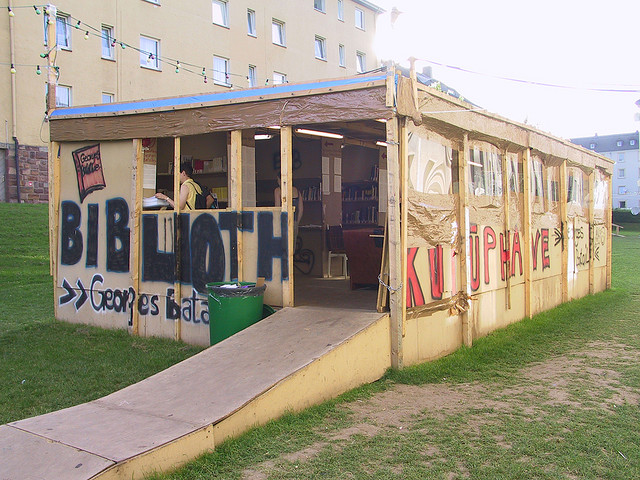
Thomas Hirschhorn, Bataille Monument (2002) Image: Emile Estelli via Flicker


With comments like I am “an artist and not an animator, teacher or social worker” Thomas Hirschhorn is one such artist who calls for the type of reading Bishop can bring. Bishop has written at length about his work Bataille Monument (2002), which was presented in a remote Turkish suburb of Kassel as a part of Documenta XI. In the middle of this working class, immigrant community Hirschhorn set up makeshift structures to house a library, TV studio and bar in hommage to the surrealist writer Georges Bataille. Documenta audience members were ferried out to the site by scarce Turkish taxis.


The only thing visitors were required to do at the site was to think about the material offered. Hirschhorn doesn’t give control to the audience, or recruit them to fulfill a role in completing the work. Rather, Bishop suggests, there is a mutual power play in operation, where the artist relies on the “participants creative exploitation of the situation he or she offers, just as participants require the artist’s cue and direction.” Rather than trying to enable complete audience control, what results, Bishop argues, is a tension “of recognition and dependency more akin to the collectively negotiated dynamics of stand up comedy or BDSM sex than to a ladder of progressively more virtuous political forms.”


By bringing two different communities together Hirschhorn was not trying to model social cohesion through shared collaborative experience. Actually, in complete contrast to Rirkrit Tiravanija’s curry lunches, there was an uneasy clash. This riled ethically versed critics like Maria Lind who criticized Hirschhorn for “exhibiting and making exotic marginalized groups and thereby contributing to a form of social pornography.” But Bishop points out that the “zoo effect went both ways” and that it was important that these two communities were not pedantically reconciled; that the gap between them in society was reflected in the work. Even more so, Hirschhorn exposed contemporary art’s self-delusion as an all-embracive domain.


Bishop explains that while there is no audience empowerment or simulated utopia in works such as Hirschhorn’s, these works do enact a crucial principle of democracy: antagonism. Sustained conflict, not resolution, between between ideals and practicalities (while resisting totalitarianism) is a symptom of a functioning democracy. Without antagonism there is only imposed consensus and suppression of debate. Acknowledging that conflict is not only unavoidable, but crucial, is not to give in to political deadlock, but to suggest that antagonism allows for new political frontiers to be continuously imagined and debated.


Bishop’s argument is that evaluation of art should be based upon the way artists and artworks reflect the irreducible tension between aesthetic autonomy and social intervention. The alternative she sees to palliative, prototype art is work that stirs unease, inviting affective responses and the possibility “to confront darker, more painfully complicated considerations of our predicament.” With this comes the need to value art’s ability to ignite imagination to and stir emotions, while also acknowledging the limitations of what is possible as art. Ultimately, it is art’s ability to embody contradiction that holds the most promise for Bishop. What she values the most is work, and criticism, that does not sacrifice the aesthetic in favor of social change, but to see the contradictions in art as inherently productive.


This is where I hope Bishop focuses for her book, because I think there are still a lot of unpacking to do and questions that need addressing. Questions such as: can participatory art open up new ways of thinking whilst relying on the historical language of art and only speaking to those who understand this language? Can participatory art cross the boundary between the social and aesthetic, whilst still claiming a distinct critical space for itself in the aesthetic realm? Isn’t Bishop, in her criticism of ‘banal’ participatory art, herself making a ethical argument about not wasting the disruptive potential of the aesthetic?


I don’t see Artificial Hells bringing an end to the conversation; I see a new wave of dispute on the horizon. Critics, such as Grant Kester, will surely continue to protest Bishop’s contraining of art to an indirect engagement with politics. They will continue to point out her apparent acceptance of the economic privilege and social prestige of art and their belief that Bishop calls for obtuse artworks specifically to legitimize her role as interpreter. But, no matter where you stand on the issue, a rowdy battle is better than quiet acquiescence.

_____________________


Source texts/Further reading:


Bishop, Claire ‘Participation and Spectacle: Where Are We Now’ presented at Creative Time’s Living as Form lecture series http://www.creativetime.org/programs/archive/2011/livingasform/talks.htm


Bishop, Claire Participation 2006, London: Whitechapel and MIT Press http://www.anti-thesis.net/contents/texts/references/bishop-participation.pdf


Bishop, Claire ‘The Social Turn: Collaboration and Its Discontents’, Artforum, February 2006http://artforum.com/inprint/issue=200602&id=10274


Bishop, Claire ‘Rate of Return: Claire Bishop on the Artist Placement Group’ Artforum, October 2010http://artforum.com/inprint/issue=201008&id=26419&pagenum=0


Bishop, Claire ‘Something for Everyone: The Art of Pawel Althamer’, Artforum, February 2011, p.175-181


Bishop, Claire ‘Antagonism and Relational Aesthetics’, October, no. 110, Autumn 2004 p. 51-79http://www.marginalutility.org/wp-content/uploads/2010/07/Claire-Bishop_Antagonism-and-Relational-Aesthetics.pdf


Charnley, Kim ‘Dissensus and the politics of collaborative practice’ Art & the Public Sphere

Volume 1, Number 1, 2011 p. 37–53http://www.intellectbooks.co.uk/File:download,aid=10623/aps.1.1.37.pdf


Kester, Grant ‘Another Turn: A Response to Claire Bishop’ Artforum, May 2006http://www.couldyoubemorespecific.com/research/grant-kester-response-to-claire-bishop-‘another-turn’/


Rancière, Jacques The Politics of Aesthetics: The Distribution of the Sensible, 2004, Translation and introduction Gabriel Rockhill, London and New York: Continuum International Publishing Group Ltdhttp://books.google.com/books?id=hzdyW_an6gUC&printsec=frontcover#v=onepage&q&f=false


Rancière, Jacques ‘The Emancipated Spectator’ ArtForum, March 2007http://findarticles.com/p/articles/mi_m0268/is_7_45/ai_n24354915/


Rancière, Jacques Aesthetics and Its Discontents, 2009 Translation Steven Corcoran, Polityhttp://www.aaronvandyke.net/summer_readings/Ranciere-Problems%20and%20Transformations%20of%20Critical%20Art.pdf


Roche, Jennifer ‘Socially Engaged Art, Critics and Discontents: An Interview with Claire Bishop’Community Arts Network http://www.scribd.com/doc/45545670/an-Interview-With-Claire-Bishop


Published: Artengine and Vague Terrain 26 Sept 2011 http://artengine.ca/blog/?p=2500

Friday, August 5, 2011

Moving among moving images: Philomène Longpré’s Xia


Philomène Longpré Xia, courtesy Gallery 101, photographer David Barbour


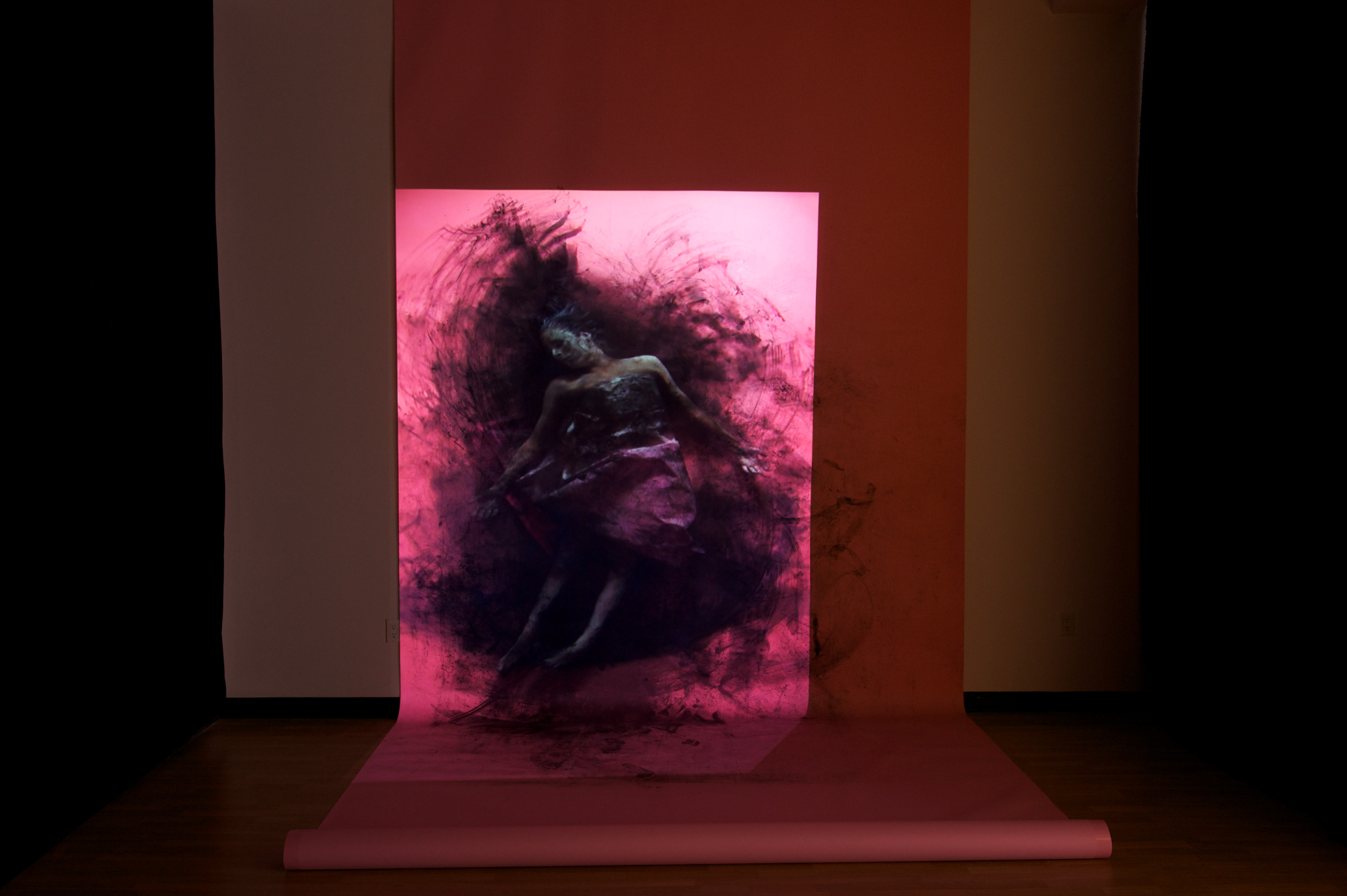
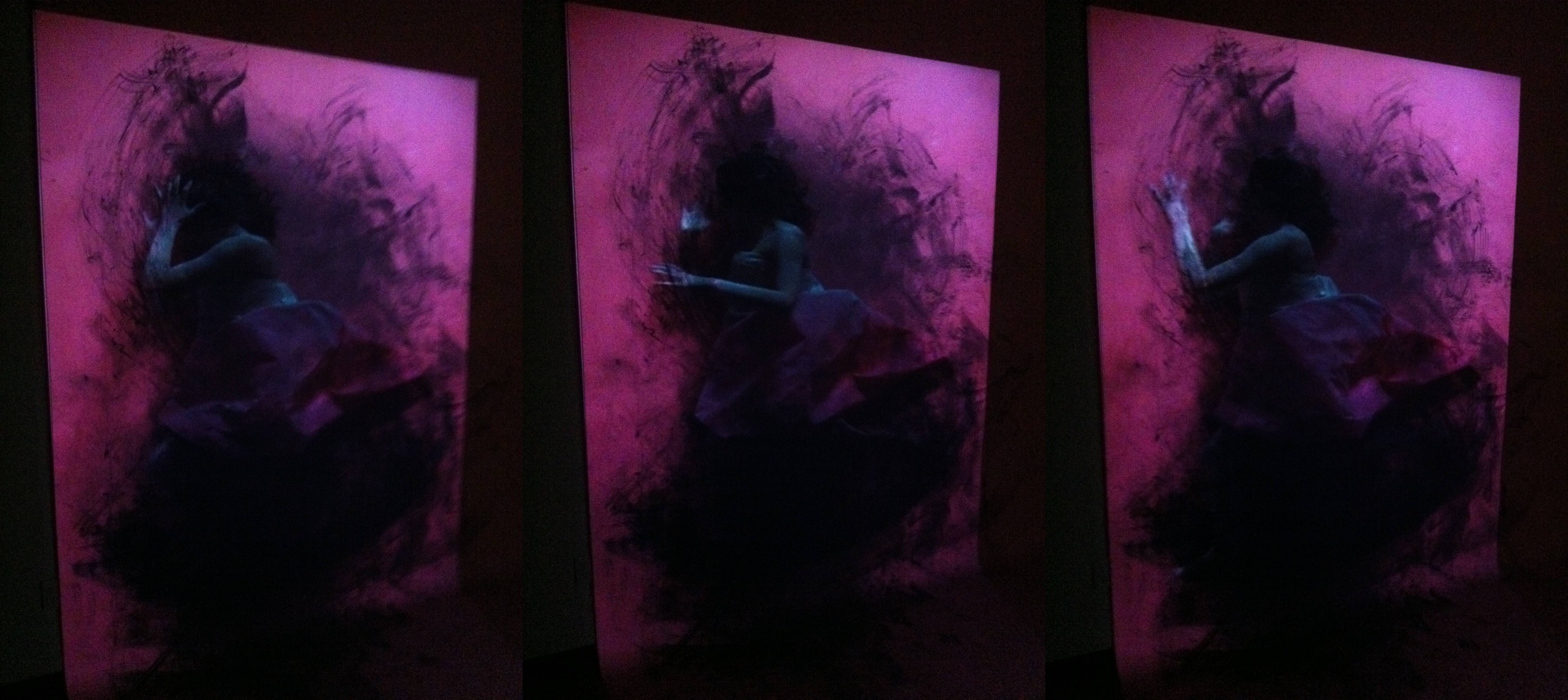
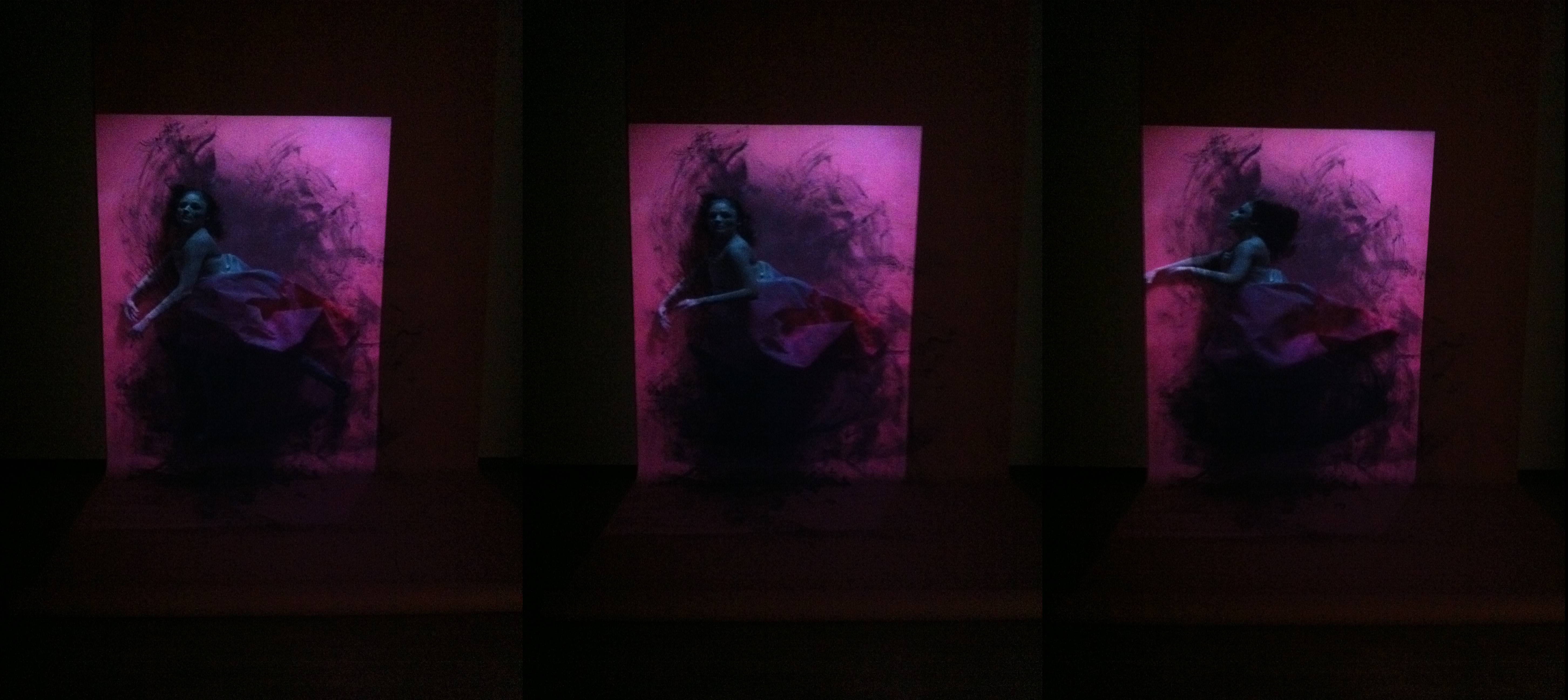
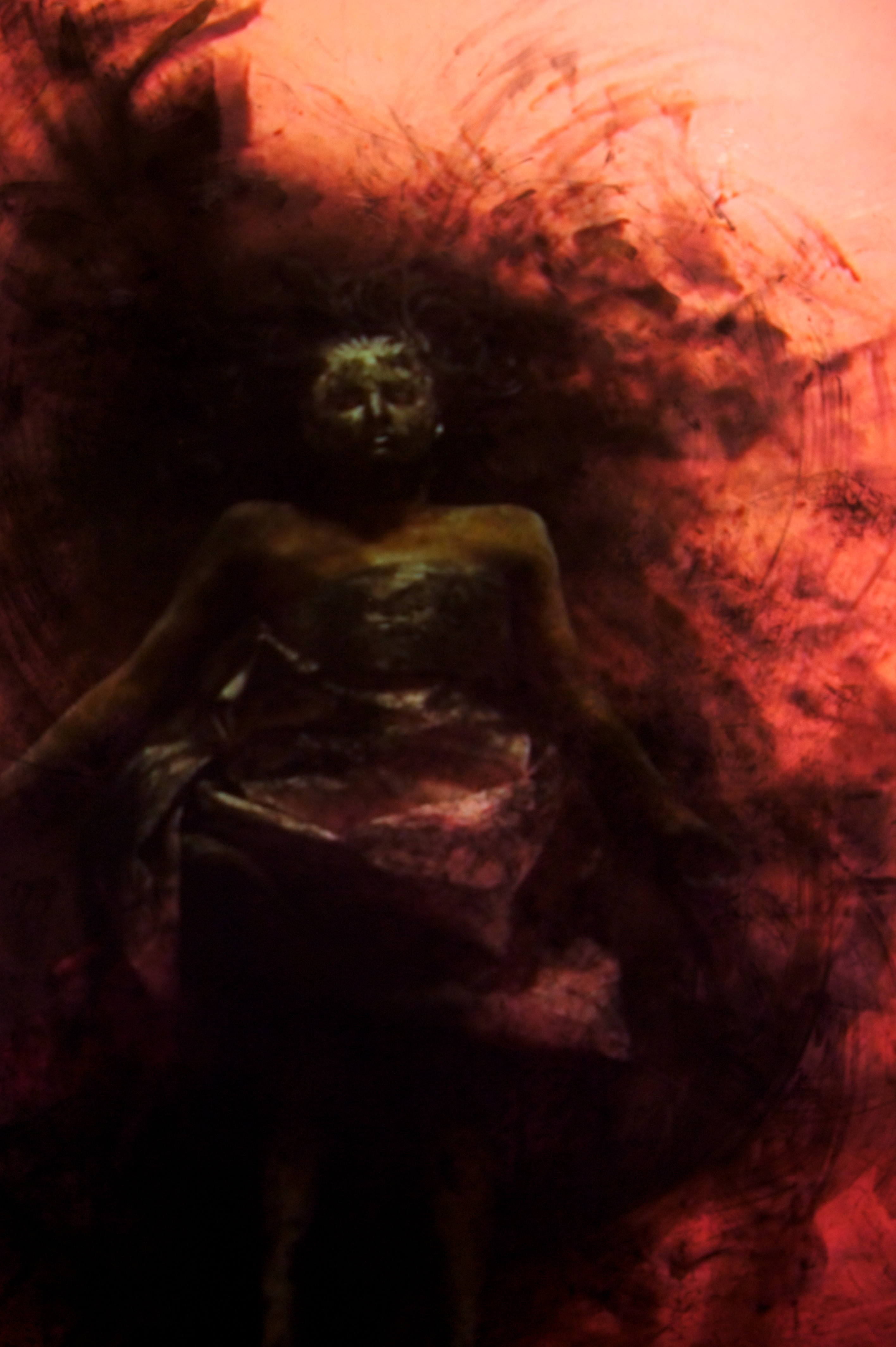
Xia, a video installation by Montreal based artist Philomène Longpré, caught my eye recently at the Gallery 101 show Body Tracks | Traces de corps (10 June - 9 July) in Ottawa*. It was given prominence, taking over the entire back half of the exhibition space with the rest of the, mainly video, works all reduced to monitor size. It certainly needed and warranted the space.


Xia looms as a cool projection of a woman cast onto a backdrop of pink canvas. The canvas rolls off the wall and along the floor into the space and the woman appears pinned to it, like a butterfly in a shadow box, trapped and on display as an allegory of beauty and mortality. Twisting, tossing, turning, resting and stretching, often with glitching, frantic movements, she gives off a nervous desperation. It is as if she is caught in a nightmare, running but getting nowhere. Her frantically flailing limbs spread heavy charcoal marks across the rich rosy-pink backdrop. The drama of the piece is heightened by the lighting—an extreme chiaroscuro, which could easily be described as Caravaggesque tenebrism. The strong shadows and highlights sculpt the rumpled fabric loosely wrapped around her figure, exaggerating the contours of her face and body to haunting effect.


With Xia Longpré has formed a virtual, pocket of time and space that is annexed onto our own. The space is shallow with no foreground or background; the depth is more like a relief. The camera’s point of view does not move, forming a seal between this pocket of virtual space and our own. Dark footprints lead along the pink canvas lying on the floor, like traces of someone having left this reality and leapt into the alternate sanguine atmosphere. There is a doubling of real charcoal handprints beneath their projected counterparts, in a way that produces a hint of depth. Gravity behaves differently in this other realm. The woman is suspended in space, floating as if she is in a liquid environment. Sounds of cicadas, beating insect wings, pouring water and metallic scratching reinforce the feeling that we have opened up a gate to a parallel existence.


Xia (detail), courtesy Gallery 101, photographer David Barbour


The work apparently reacts to visitors’ movements through motion sensors but I missed its responsiveness entirely. This sometimes happens with subtly interactive work that has no obvious interface. Regardless, I don’t think this detracted from my experience. I did, however, notice two subtly different phases in the piece. At some point the woman appears to be wearing a grotesque mask and the color projected onto the background turns it more coral than rose. Whether I was triggering video sequences and not noticing it, or not, the work seemed to address me more like a painting; something that would carry on being despite whether I was there or not.


Like a moving painting Longpré’s work is similar to that of video artist Bill Viola’s (interestingly Viola just received an award for painting). Beyond opening up another virtual, illusionistic space on the surface of the pink canvas Longpre, like Viola, references the painting tradition, with its lighting, static frame, and figure placed at the centre of the composition, at a scale proportional to our own. Both artists also treat time as material, slowing down and speeding up movements in a way that renders them surreal and supernatural. While it is often hard to know whether the loop of a video installation is merely conventional or intentionally meaningful, repetition seems inherent to the reverberating space Longpré has constructed. The woman in Xia is trapped in a prison of a collapsed present, sliding down a spiral of infinite regress. This is artificial, digital time. Time that slips out from under standard linear perceptions and progressions. Like Viola, Longpré’s work is highly crafted, lyrical and poetic and makes the most of advances in ever affordable and accessible digital technologies.


Ana Mendieta, Untitled aka Body Tracks (Blood Sign #2) 1974


The publicity draw-card of the show is Ana Mendieta and the mystique surrounding her (and her untimely death). The curator (and author of a graphic novel based on Mendieta’s life, also featured in the show) has selected Mendieta’s Untitled aka Body Tracks (Blood sign #2), 1974 as the headlining work of the show. In this performance Mendieta drags her blood soaked arms down a wall with a simple, sweeping, singular gesture. The mark she creates is elemental, iconic and can be read in any number of ways: tree, uterus, pictograph… Unfortunately, the video was not well presented in the show, positioned too close to the entrance on a rather rough translucent screen.


The ties between Mendieta’s work and Longpré’s are easy to thread: the body as paintbrush, the critical feminist undercurrent, the power of a single expressive gesture. The female body as a site of expression and resistance, crystalised in video, is a theme that runs across the whole show. Video works by Jude Norris and Anna Peak similarly hinge around a singular expressive gesture enacted by a strong female individual. They lend a context for Longpré’s work to be read within. In exchange Xiaadds nuance into the exhibition narrative; the feminine character depicted here is in turn determined and trapped, beautiful and frightening.


Body Tracks is awash with screens, a symptom of an art world swamped by moving images. This trend is so pervasive critic Dominique Païni even went so far as to pen an article for the journal October entitled “Should we put an end to projection?” This sentiment is a far cry from a pre-90s era where video struggled to gain recognition in the art world. Now everything else lives in its shadow. With a quick lick of paint the white cube has become a black box. Phrases like new media or multi media installation still resound as metonyms for video installation. Nine times out of ten when you read or hear the phrase “new media work” you can bet it means “there’s a projection.”


In his article Païni charts a parallel art history of projected light; one of images dematarialized and made more spectacular transforming the viewer into a contemporary flaneur, who browses and flits between video installations like a window shopper. Art historian Kate Mondloch asks “by creating media installations that support or even require visitors to determine the length of their experience with the work, might artists unintentionally provide for a spectatorship characterized by short attention spans?”


It would be easy for us to see the art world’s insatiable desire for ever larger audio visual installations as a way to draw in crowds with quickly digestible spectacles and just as easy to see the desire for video as simply manifesting a desire for the new. Though to indiscriminately rebuke artists’ continuing interest in video as merely trend following or crowd pleasing fails to see that, as Mondloch puts, it we are living in a “society of the screen.” We are subsumed by the moving image in its many forms: projections, monitors, computer screens, smartphones; cinemas, electronic billboards, youtube… to the point where it is hard to get critical distance. The screen has replaced the painted or printed image as the foundation for contemporary visual communication. As it continues to become more pervasive and more universal, blending illusionistic and information spaces, Mondloch suggests we will need to continue to “think through our thinking through media screens.”


_____________________


*Xia will be shown again, within a modified exhibition, at FOFA Gallery, Concordia University, Montreal from 6 September to 10 October 2011.


John Sobol, reviews Body Tracks with specific attention given to the graphic novel Qui est Ana Mendieta?/Who Is Ana Mendieta?: http://www.canadianart.ca/online/reviews/2011/07/21/ana_mendieta/


Kate Mondloch Screens: Viewing Media Installation Art (2010) University of Minnesota Press


Published: Artengine and Vague Terrain 5 August 2011 http://artengine.ca/blog/?p=2448