Friday, November 25, 2011

Electric Fields: Electric Pow Wow

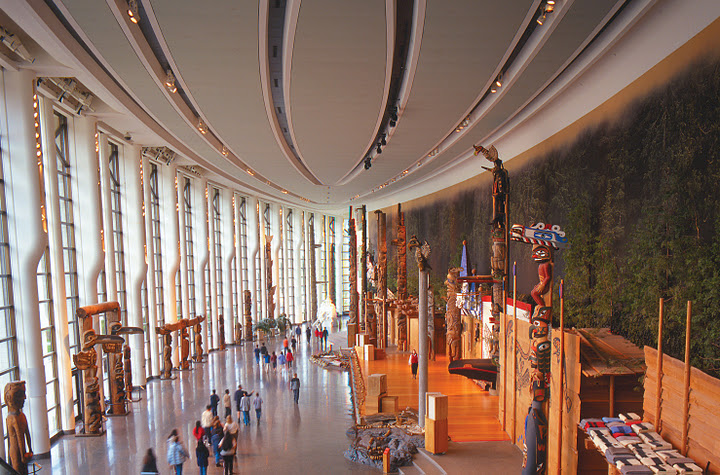
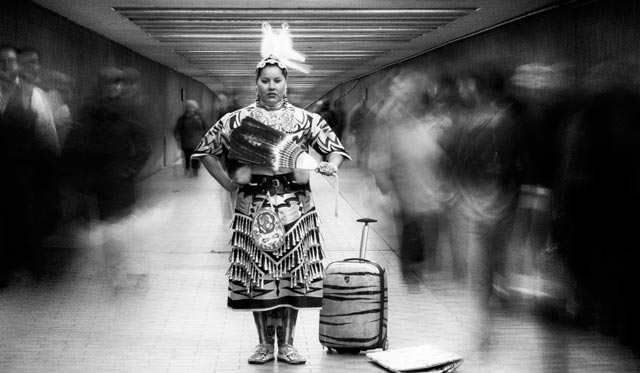
Tonight, from 10pm to midnight, A Tribe Called Red will be performing in the Grand Hall at the Canadian Museum of Civilization (CMC) in Gatineau.The three DJs that make up A Tribe Called Red are Bear Witness, Ian Campeau (a.k.a. DJ NDN) and Dan General (a.k.a. DJ Shub). MTV has dubbed them originators of their own genre called ‘electric pow wow’ or ‘pow wow step’ formed from a remix of traditional pow wow music with club beats. The group has developed a solid following in Ottawa and beyond, throwing monthly dance parties sampling from a broad catalogue and accompanied by projections of videos composed by Witness.

Grand Hall in the Canadian Museum of Civilization. Image courtesy Ottawa Tourism
There will be no video component for this performance because, as Witness explains “the general idea for Electric Fields is to find different ways to work with spaces and any screens would take away from this.” Instead the group are going to realize an idea they have been thinking about for years now. “When this project came up it was an opportunity for us to try out a bunch of things that we have been wanting to do” says Witness. They will arrange themselves and their gear a small circle in the middle of the dance floor, as apposed to being on stage, which is their typical setup. “We are going to be setup with our backs to each other and people are going to dance around us, like at a pow wow, where you have a drum in the middle and people dance around” explains DJ Shub.


For this performance they will also be working with a singer, Rhonda Doxtator, who is one half of the Pimadiziwin Singers. “We’ve never played a show with a singer before, who is going to be singing with us live, so that is going to be exciting” says DJ Shub. Doxator has performed with A Tribe Called Red in the past as a dancer, but for this night she will feature as a live vocalist for a few of the songs.

A Tribe Called Red. Image courtesy of New Forms Festival
The group are navigating the gap between the interests of their club crowd and an arts crowd. “We are going to shake up the CMC, like literally.” says Witness “Our music tends to do that. We want to shake those archives up. Shake ‘em old bones. It’s like we are going in there to play for those people, those energies that are stuck in that space. It is going to be a lot different energy than playing in a club…It is such a charged space, being in the CMC, the history of the CMC and all the artifacts, belongings and well, people who are housed there. It is an interesting space to take over.”

With three DJ’s playing at the same time, they alternate at taking the lead with DJ Shub adding scratches and flares using more ‘traditional’ turntables. “We work as a group, more than three DJs on stage doing their own thing” says DJ NDN “Sort of like a band almost, but not really. We are all improvising with our own instruments.”

Red Skin Girl single cover image by A Tribe Called Red
To date, A Tribe Called Red have released one single; Red Skin Girl. “The reason we only have Red Skin Girl out as a single is because it is the only one we have licensed to use the samples for. And that is why we give the rest away.” Red Skin Girl is a remix of a round dance song by contemporary pow wow singing group, Northern Cree. In addition to the vocables in traditional pow wow, round dance often includes English lyrics; stories of love and heartbreak. A Tribe Called Red have used the distinctive two step swing of round dance, speeding it up, adding layers and bass. You can listen to it here:http://soundcloud.com/a-tribe-called-red/red-skin-girl-atcr-remix

DJ Shub explains that “with any type of sampling music it is always difficult and expensive to get cleared. But there is light at the end of the tunnel because our manager has come to an agreement with Cannon Records, so hopefully they will be opening up their catalogue for us.” Witness adds: “the next step now is to start recording. So we are bringing people in to do studio sessions so we own all the tracks, and get out of having to license samples.” For now, you can download their music for free from SoundCloud: http://soundcloud.com/a-tribe-called-red

As recordings of pow wow music only go back 40 – 60 years, with the cultural ban only being lifted in the 1960s, most of the source material they want to work with is still under copyright. “Before that people were part of sideshows and wild west shows and could perform as part of that, so things survived. But as far as what you could do in your community…nothing” explains Witness. A lot of archival material exists in the US, in institutions such as the Library of Congress and the University of Indiana. The group are interested in exploring these older archives and just did a project with UCLA, where they were sent digital copies of recordings taken in the 1930s and etched onto wax cylinders. Their result, General Generations, can be heard here: http://ethnomusicologyreview.ucla.edu/journal/volume/16/piece/471

First published on Artengine 25 November 2011

Thursday, November 24, 2011

Electric Fields: Church Music

Roger Tellier-Craig will be one of the three performers showcased tomorrow night at 9pm at St Brigid’s Center for the Arts a part of Electric Fields. Two other performances will be Martin Bédard and Jean François Laporte. The line-up has been orchestrated through collaboration between Artengine and Montréal based electro-acoustic festival Akousma.


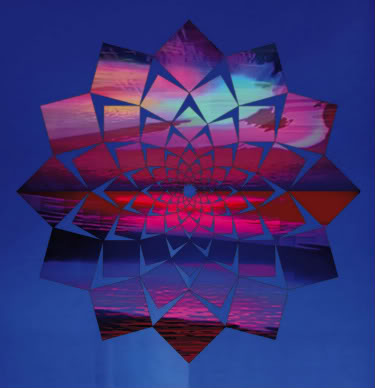
Le Révélateur – Fictions [Gneiss Things; 2011]

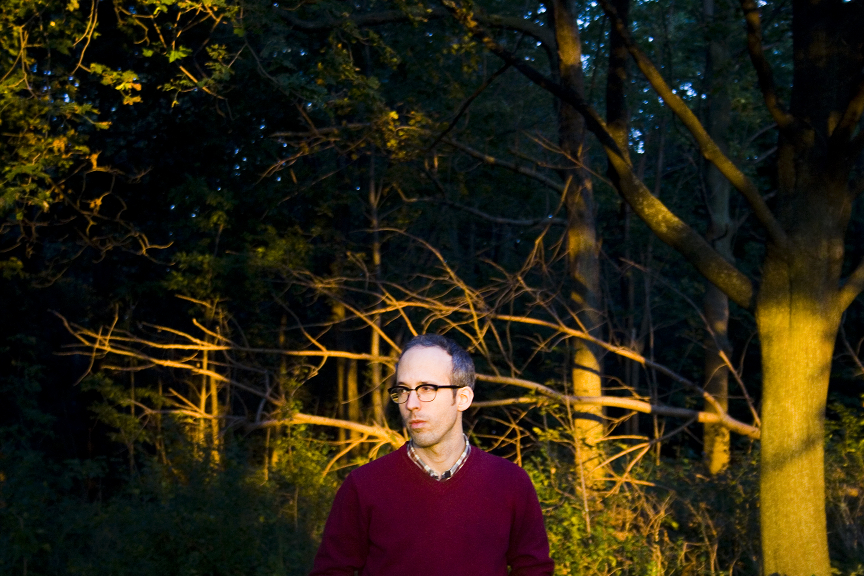
For Electric Fields Tellier-Craig will be performing live with a late 1970s Roland analogue mono-phonic synthesizer, blended with tracks from his new record Fictions. The structure of the music is computer sequenced, but the lead voice will be performed by hand by Tellier-Craig on the synth. Normally, when Tellier-Craig performs he does so as a duo under the name Le Révélateur, with Sabrina Ratté who creates corresponding moving images that play homage to late 1970s early 1980s computer video artists like Lillian Schwartz, Laurence Gartel, Toshio Matsumoto, Larry Cuba, Erkki Kurenniemi, etc. but the focus for Electric Fields will be purely on the sound.


Roger Tellier-Craig. Image courtesy of  Sabrina Ratté.

Known mostly from his time as a guitarist in the instrumental, minimalist post-rock bands God Speed! You Black Emperor and Fly Pan Am, Tellier-Craig has always been interested in synthesizers and electronic music. After overcoming the learning curve required to play the synth, he was hooked. “It just so much more sense to me than playing guitar. Guitar has never been something I really liked that much.”

Tellier-Craig has an interest in the historical legacy of older technologies. “When I first heard sequencers I thought they were cheesy and found them kind of kitsch.” But as he dug further into the technology and it’s history he began to realize that at some point in time synthesizers were new, and their kitsch associations have come through overuse in cinema, television and mass media.

He became interested in recontexualizing synth sounds by putting them in conjunction with other sounds from different eras. Tellier-Craig combines dense atonal and discordant sounds with new age music, with all it’s excessive historical baggage. He contrasts references to the Berlin school of electronic/pop music with density and noise inspired by Iannis Xenakis’ pioneering use of mathematical models in music. This mix-up and confusion is something that interests Tellier-Craig; he sees it as a challenge to move beyond comfort zones and familiar styles. While he takes inspiration from older music and technologies, his aspiration is for his music to move beyond updating and seek out challenging and uncomfortable surprises. The reverb inside St Brigid’s will present a different kind of challenge, and will require some adaptation to work with the ten speaker surround sound system and the acoustics of the space.

All music on the night will be taken from his latest album Fictions, with a limited run of 500 there are only 100 left to purchase online from the label Gneiss Things and Forced Exposure. Listen to a sample from the album, a track titled Age Maze, which will feature in the Electric Fields performance:http://soundcloud.com/le-revelateur/age-maze

First published on Artengine on 24 November 2011.

Wednesday, November 9, 2011

Electric Fields: Swimming in Sound


Champagne Baths. Image courtesy Wikipedia Commons


Bring your swim suit to this one-of-a-kind sound performance at Ottawa’s first municipal swimming pool. Composer and percussionist Jesse Stewart and new media artist Rob Cruickshank will perform at 10pm on Friday 25 November at the Champagne Baths, 321 King Edward Drive. Capacity is limited; advance tickets can be purchased for $10 from everybody@artengine.ca


For this performance, Stewart and Cruickshank will flood the space with percussive and electronic sounds. “I want people to be swimming in sound” says Stewart, who often experiments with water in his work across visual and sonic media.


Stewart’s large transparent drum kit will be staged on a platform in the pool, to appear as if it is floating on water. Throughout the performance Stewart will switch from playing his drum kit to dipping other percussive instruments, like gongs, into the pool. “The addition of water, lowers the pitch” explains Stewart. People swimming underwater will hear these warped acoustic sounds, which will be picked up by underwater microphones, called hydrophones, floating below the surface of the pool.


The hydrophones have been specially created by Cruickshank to transport the sound in the pool back through speakers into the space. Performing outside of the pool, Cruickshank, will be relaying and electronically processing the sounds he collects from the microphones, live. His performance will also blend in his own synthesized creations to the sampled sound he will process.


Waterphone


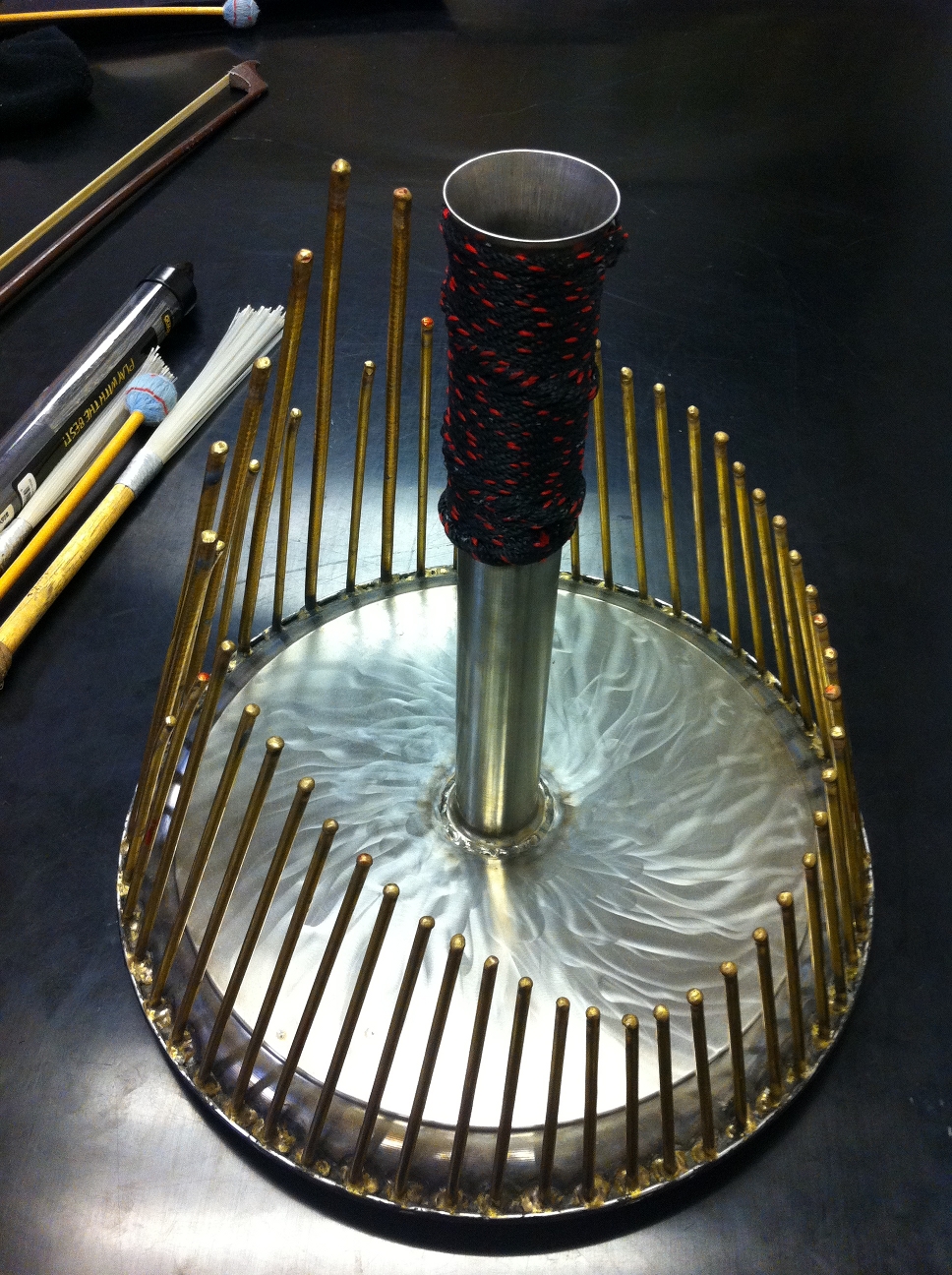
Audience members will also be treated to a performance of Stewart’s waterphone: an instrument constructed from bronze rods welded to a metal base that contains water. When struck or bowed, the vibrations of the bronze rods resonate through the hollow base. Sloshing the water around inside the base warps the sound, creating a series of eerie bent notes. The sound this instrument produces has a strangely electronic quality—an ambiguity the artists want to harness. They will blend acoustic and synthesized sounds and physical and electronic manipulation, to the point where it will be difficult to discern the difference between the two.


Stewart and Cruicshank’s audible landscape will span from haunting electronic sine waves to irregular jazz rhythms. They have a structure in mind, but their performance will be “largely improvisationial” says Stewart.


When they are performing they will respond the unique sound properties of the pool with it’s echoing tiled surfaces and potential for underwater phonics. “It is such a live space” adds Cruickshank. The unique reflections and reverberations of sound, shaped by the surfaces of the building’s interior, the water and the audience, will determine the character of the sound audiences will hear on the night.


Stewart and Cruickshank have never collaborated before. Their pairing has been co-curated by Vague Terrain and Artengine. “At a base level the project builds a bridge between the Toronto and Ottawa art communities” explains Greg Smith from Vague Terrain; a web based digital arts publication based in Toronto. Vague Terrain and Artengine have worked on projects together before, but these have mostly been virtual. Swim Sound is the first project that has branched out into real space, and fitting with the theme of this year’s Electric Fields is concerned with the particularities of a very distinct acoustic environment.


Stewart is an composer, musician, artist, and Assistant Professor of Music at Carleton University, Ottawa. Local audiences may remember him, and his transparent drum kit, from his performance under Barnett Newman’s $1.8 million dollar Voice of Fire painting at the NAG, or his recent exhibition of installation-based visual art at the Karsh-Masson Gallery.


Cruickshank is a multi-disciplinary artist, based in Toronto. He has been a board member at the artist-run centre InterAccess ( http://interaccess.org ) and has a deftness with electronics, which he will bring to the performance; having wired up his own underwater hydrophones and custom built the synthesizer he will be performing on.


The project has fostered some very ambitious thinking alongside creative problem solving. At one point in the evolution of the project the duo were brainstorming with architect Adrian Blackwell to put an iceberg in the pool. Shifting to accommodate the regulations that come with working in a public space, restrictions about working around water, and specific requirements of working within a historic building, as well as the complexities of remote planning, has seen the project evolve over time. It is a process that will only come to an end in the moment of the performance, making the process an experience and exploration for both the audience and artists.


The performance will last for approximately half an hour. Swimmers, please come early to change. Please note that the water at Champagne Baths is cooler than most, at a tepid 80ºF/26ºC. Wheelchair access is available, please contact Champange Baths 613-244-4402 for more information.


Swim Sound is presented in collaboration with online journal Vague Terrain.


First published on Artengine on 9 November 2011